
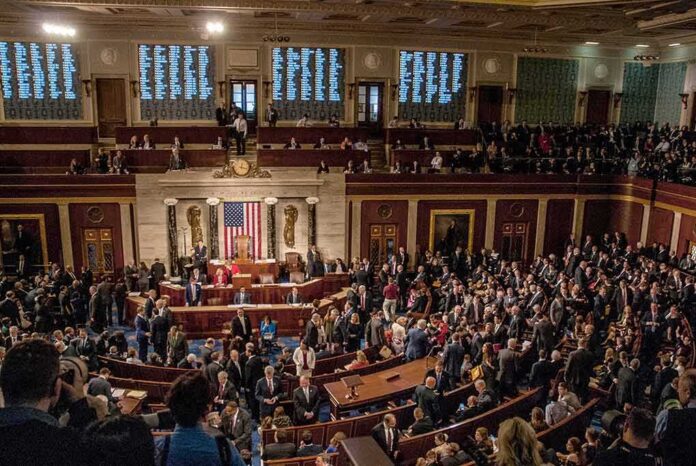
Congress just handed a sitting president a $900 billion military wish list—and buried inside it is a quiet blueprint for how America plans to fight, spend, and project power for the next decade.
Story Snapshot
- The Senate approved a roughly $900 billion defense policy bill backing President Trump’s national security agenda
- The bill reshapes how the Pentagon buys weapons and modernizes the force for great‑power competition
- The legislation reflects hawkish priorities on deterrence, readiness, and projecting strength abroad
- The long‑term costs, tradeoffs, and oversight gaps remain largely invisible to most taxpayers
How a Single Vote Greenlit Nearly a Trillion Dollars of Hard Power
The Senate delivered final passage to a defense policy bill approaching $900 billion, effectively endorsing the bulk of President Trump’s national security blueprint and sending the legislation to his desk for signature. Lawmakers framed the measure as essential to readiness, deterrence, and modernization, while quietly locking in years of elevated spending that will outlast any single administration. Voters watching Washington gridlock on domestic issues just saw national defense sail through with broad, disciplined support.
The bill’s sheer size does more than fund ships, jets, and salaries; it signals to adversaries and allies that the United States intends to remain the world’s preeminent military power. A defense authorization at this level effectively commits future Congresses to sustain high outlays for maintenance, training, and follow‑on procurement. The package advances Trump‑era priorities such as rebuilding conventional strength, accelerating modernization against China and Russia, and reinforcing nuclear and missile defense programs that conservatives typically view as non‑negotiable pillars of deterrence.
What the Bill Tries to Fix Inside the Pentagon
The legislation does not only pour money into existing systems; it attempts to rewire how the Department of Defense buys and fields new capabilities. Lawmakers backed changes aimed at cutting bureaucratic delay, speeding up acquisition, and pushing the Pentagon toward emerging technologies that match the era of cyber conflict, unmanned systems, and long‑range precision strike. Supporters argue that an aging procurement culture cannot keep pace with authoritarian rivals that integrate industry and military planning without the same political friction.
Reformers inside Congress used this bill to press the Pentagon toward more agile decision‑making, while still protecting marquee programs that anchor jobs in home states and districts. That tension—between efficient modernization and political protectionism—runs through the entire package. From a common‑sense conservative perspective, tightening oversight on waste while still investing heavily in core war‑fighting capabilities aligns with the belief that government should be strong where it must be, and lean where it can be.
Trump’s National Security Agenda, Codified in Statute
Advancing most of President Trump’s national security agenda through this bill means more than a headline victory; it hardwires many of his priorities into law where they become harder for successors to unwind. The focus on great‑power competition, increased defense budgets, and skepticism toward deep cuts in nuclear forces all gain statutory backing. Once entrenched in policy language and multi‑year procurement lines, these choices gain institutional inertia inside the Pentagon and the defense industry.
Senate Passes Defense Policy Bill, Clearing It for Trump The legislation authorizes $900 billion for the Pentagon, provides a pay raise for troops, and has some measures to reassert congressional oversight.. @CosmicMetaX #Defense
— Cosmic Meta Digital (@CosmicMetaX) December 17, 2025
Conservatives often stress peace through strength, and this authorization reflects that philosophy. The wager is straightforward: a robust, visibly capable military discourages miscalculation in Moscow, Beijing, and Tehran. Critics warn that such large, recurring authorizations risk normalizing nearly trillion‑dollar defense budgets while Social Security, Medicare, and domestic priorities face constant fights. That debate over tradeoffs is only beginning, but the bill moves decisively in the direction of sustained hard‑power investment.
Who Pays, Who Benefits, and What Comes Next
Taxpayers ultimately fund the $900 billion commitment, yet most never see the line‑item details, only the political narratives about strength or waste. Defense communities, major contractors, and allied nations that depend on U.S. security guarantees all stand to benefit from a steadier flow of money and hardware. The risk, from a fiscal conservative standpoint, is that high baselines and bipartisan habits of “plus‑ups” make it far easier to grow the Pentagon’s budget than to trim it when threats recede or priorities shift.
The next fights will center on how the authorized programs perform, whether promised efficiencies in procurement actually materialize, and how well these investments deter aggression without dragging the country into open‑ended conflicts. Oversight hearings, inspector general reports, and public scrutiny will determine whether this enormous bill represents responsible insurance in a dangerous world or another example of Washington writing checks today and leaving the hard questions to tomorrow’s voters.