
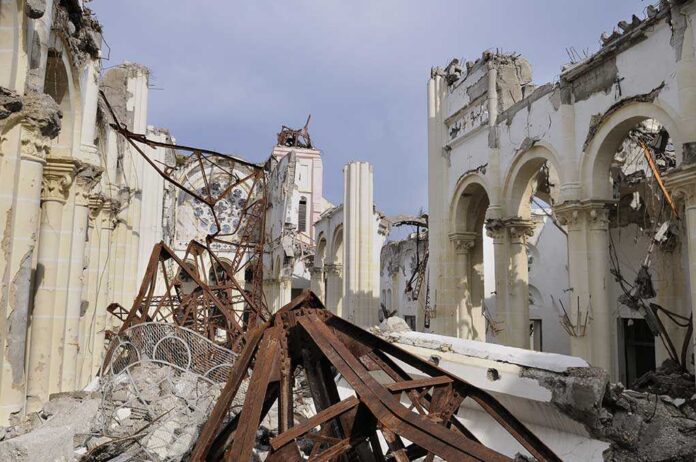
The old St. Ann’s Catholic Church in Buffalo did not die of neglect; it went down in flames officially ruled arson, on land already tangled in a fight over whether its next life would be as a mosque.
Story Snapshot
- Buffalo officials ruled the latest St. Ann’s Church fire to be arson.
- The blaze hit a vacant landmark already scarred by multiple recent fires.
- The church complex had been sold for a planned Muslim worship and community center.
- The fire lit up deeper questions about heritage, redevelopment, and religious change.
A historic Catholic landmark goes dark in a deliberate blaze
The former St. Ann’s Catholic Church on Buffalo’s East Side has stood for more than a century as a stone witness to immigrant faith and neighborhood struggle. That witness ended in a plume of smoke. Fire crews rushed to the vacant church complex after flames broke out again, the second fire there in less than a week and the third incident on the property this year. This time, officials did not hedge. The Buffalo Fire Department announced the cause of the Tuesday blaze as arson, meaning someone intentionally set the fire.
🚨🚨BREAKING NEWS 🚨
🇺🇸 Second Blaze Hits 140-Year-Old St. Ann’s in a Week as Conversion Push Intensifies
A 140-year-old church in Buffalo, New York, has suffered its second fire in seven days. St. Ann Church was hit by what authorities are investigating as arson, coming just… pic.twitter.com/aA6MmJKQna
— Corefrontline (@corefrontline) July 23, 2026
Earlier in the week, investigators were more cautious. After fighting a three-alarm fire at the rear of the church, the fire commissioner stressed that there were no working utilities inside the building, pointing instead to “a human element” as the likely source of the flames. He described a makeshift bed at the ignition point and boards torn off windows, signs that squatters or trespassers had used the structure before the fire. He stopped short of calling that earlier blaze arson, but the pattern was hard to ignore.
Repeat fires on contested ground raise the stakes
The St. Ann’s site was not just another empty building. The parish closed years ago, and in 2022 the Catholic Diocese sold the church complex to a private investment group, Buffalo Crescent Holdings, with plans to turn it into a Muslim worship space, community center, and health care facility. That kind of conversion, from Catholic church to mosque, touches nerves. It blends zoning debates, historic-preservation fights, and the country’s unease about rapid cultural change. When a long-vacant Catholic landmark on that path suddenly burns, people on social media do not wait for facts. They jump straight to motive and blame.
Local coverage shows how quickly the situation escalated. A four-alarm fire in January gutted the former school building on the same grounds, leaving a roofless shell and at least $600,000 in damage. That earlier blaze did not damage the main church sanctuary, but it put the entire complex under a “collapse zone” warning and raised tough questions about who would pay for demolition and how much of the site could be saved. City officials said squatters had been living inside, yet they could not finish the investigation because the structure was too unstable to enter. Against that backdrop, the next fires felt less like random misfortune and more like a slow-motion end.
Arson is settled, motive is not
The latest fire crossed an important line: arson is now an official finding, not just online speculation. That means someone chose to start the blaze. It does not, by itself, prove why. American investigators tend to move slowly on that point. They separate the technical fact—incendiary cause—from bigger questions of hate, profit, or protest. Often, vacant buildings burn because of trespassers, vandalism, or insurance games, not organized religious hostility. National fire data show that most structural fires are accidental, but arson is more common in abandoned, unsecured, or repeatedly hit sites, just like St. Ann’s.
This gap between “it was arson” and “here is who did it and why” is where rumor thrives. Some locals and online voices argue the timing is too neat: a Catholic church sold for a mosque project, then suddenly torched, clearing the way for something new. Their frustration echoes broader conservative concerns about losing Christian symbols, watching historic churches close while new mosques and other centers rise. That anger is real. But right now, it rests on emotion and pattern, not direct proof. The public record does not show authorities tying the fire to any mosque backers or to an explicitly religious motive.
Heritage, responsibility, and common-sense questions
The St. Ann’s case still raises fair questions that fit a common-sense, conservative lens. Who guards a sacred building once the diocese shutters it and sells it off? How do city leaders balance demolition costs, safety, and historic value when taxpayers are already squeezed? Buffalo’s mayor has said the city will not spend the estimated $2 million to tear down the damaged school building, instead pushing the owners to meet their obligations. That stance matches a basic principle: private investors who buy landmark properties for ambitious redevelopment should also bear the risk and responsibility when things go wrong.
BREAKING: 140-year-old St. Ann church set on fire in Buffalo, NY
Cause determined to be arson pic.twitter.com/LlA1n5MNsp
— THE GREAT AWAKENING (@Q_1776_United) July 23, 2026
The deeper tension cuts beyond Buffalo. Across North America, historic Christian churches in urban cores are closing as congregations shrink and maintenance costs climb. Some become condos or event halls. Some become civic spaces. Some, like St. Ann’s, are slated to become worship centers for another faith. Each conversion stirs debate about identity and belonging. When fire enters that story—especially arson—the debates grow sharper. People see not just a burned building, but a burned chapter of their community’s memory. For now, investigators have drawn one clear line: the latest flames at old St. Ann’s were no accident. What they eventually decide about motive will shape how long this story smolders.
Sources:
wivb.com, wkbw.com, youtube.com, facebook.com, reddit.com, audacy.com
© integritytimes.com 2026. All rights reserved.