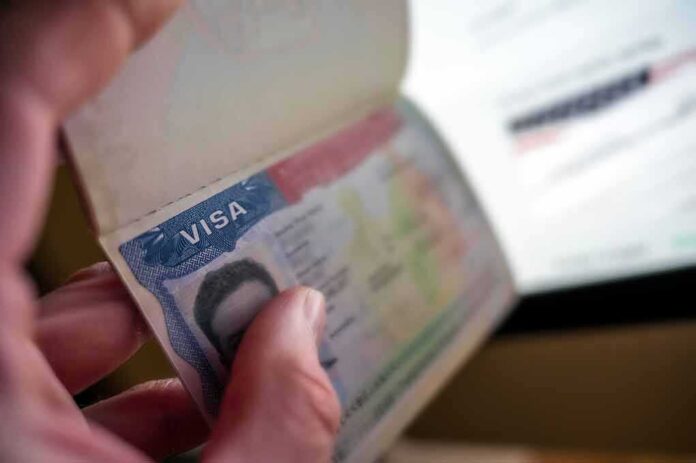
The world did not suddenly cancel visas for Americans—but the United States did slam the door on millions of foreigners, and that quiet fact may matter far more to your future than the viral rumors you keep scrolling past.
Story Snapshot
- No government coalition has moved to cancel all visas for Americans, despite heated online claims.
- The real story is a sweeping 2025 U.S. travel ban blocking immigrants and visitors from up to 39 countries.
- Those bans do not even cancel existing visas for foreigners, underscoring how extreme a blanket visa wipeout would be.
- Reciprocal crackdowns on U.S. travelers remain mostly rhetorical because many countries would hurt themselves by copying Washington.
How a Viral Myth Jumped Ahead of the Real Policy
Social media loves a clean, scary headline, and “Countries cancel all visas for Americans” sounds tailor-made to ignite outrage and panic. The documented reality, however, runs in the opposite direction. In 2025, the initiative comes from Washington, not from foreign capitals: a new presidential executive order resurrects and enlarges earlier Trump-era travel bans, targeting foreign nationals from 19 countries at first and later expanding the list to 39. That is the concrete, verifiable policy, and it is sweeping enough without embellishment.
That order blocks visa issuance or entry for broad categories of people—often all immigrants and visitors—from a cluster of mostly African, Middle Eastern, and some Asian and Latin American nations. The White House frames it as a security measure against countries that allegedly fail to share data, accept deportees, or prevent high overstay rates. Commentators upset by this imbalance then float the idea of “retaliation” against American travelers, and somewhere between advocacy, speculation, and clickbait, the rumor morphs into a supposed fact.
What Actually Changed in 2025: Who Is Banned and How
The 2025 executive action does two main things. First, it imposes full bans on both immigrant and nonimmigrant visas for nationals of roughly a dozen countries, meaning they cannot obtain family, work, study, or tourist visas at all. Second, it layers on partial bans for additional countries, targeting specific categories such as B‑1/B‑2 visitors or F, M, and J students and exchange visitors. A subsequent proclamation pushes the total to 39 countries and converts some partial bans into full suspensions.
University advisories and law-firm analyses emphasize a critical point that gets lost in the noise: these bans do not retroactively void valid visas already issued to affected foreigners. A Syrian student already inside the United States with an unexpired visa, for example, may face serious risks leaving and trying to reenter, but their current visa is not automatically canceled at midnight. That detail exposes how implausible the online fantasy is about dozens of countries mass-canceling American visas; governments hesitate even to nullify visas they themselves granted, because that type of retroactive wipeout is legally and diplomatically extreme.
Why Other Countries Are Not Nuking American Visas
Calls for “reciprocity” play well on talk shows and activist feeds, but most foreign governments must weigh principle against self-interest. The United States holds outsized leverage as a destination for study, medical care, investment, tourism, and remittances, and cutting off their own citizens from that ecosystem is costly. That asymmetry makes it rational, though hardly admirable, for many leaders to confine their responses to sharp statements, targeted measures against U.S. officials, or higher visa fees rather than an across-the-board shutdown on American travelers.
Visa policy historically operates on calibrated reciprocity, not mutually assured destruction. The European Union, for instance, has occasionally threatened to restrict visa-free travel for U.S. citizens when some EU member states lacked parity, but Brussels stopped short of wholesale cancellation. Even where relations truly crater—think U.S.–Iran or, more recently, deteriorated ties with certain authoritarian regimes—the standard playbook involves expelling diplomats, sanctioning elites, or tightening entry rules for specific categories, not ripping up the visas of every ordinary visitor already inside the country. The absence of any verified global move to cancel American visas in 2025 fits that long pattern.
What This Means for Americans Who Assume They Are Immune
Americans who dismiss the 2025 bans as “someone else’s problem” misread how precedent works. When Washington normalizes nationality-based restrictions at this scale—39 countries today, perhaps more tomorrow—it erodes the principle that individuals should be judged as individuals. A world that accepts blanket suspicion of Somali or Burmese travelers today becomes more tolerant, over time, of blanket suspicion of Americans tomorrow, especially in moments of crisis or confrontation.
From a conservative, common-sense perspective, a government has a duty to vet entrants and secure borders; that does not require punishing entire populations for the incompetence or hostility of their rulers. Critics point out that the 2025 criteria—overstay rates, data sharing, deportation cooperation—are applied unevenly and in ways that map suspiciously onto long-standing political and cultural fault lines. If the goal is real security rather than symbolic toughness, targeted intelligence work and case-by-case screening deliver more than broad, theatrical bans that invite resentment abroad and uncertainty at home.
Sources:
Guide to the Countries on Trump’s 2025 Travel Ban List
Berkeley International Office: Executive Order Visa Issuance Ban Impacting 19 Countries