The world’s most advanced aircraft carrier just sailed into the Caribbean, and with it, the fragile balance of power near Venezuela is on a razor’s edge—what happens next could redraw lines that have held for generations.
Story Snapshot
- The USS Gerald R. Ford’s arrival in the Caribbean marks the largest US military show of force near Venezuela in decades.
- Officially a counternarcotics operation, the deployment is widely seen as a warning to President Maduro and his international backers.
- US and Venezuelan militaries are now performing dueling drills, with Russia, China, and Iran watching—and possibly aiding—from the sidelines.
- Escalation could threaten global oil markets, regional stability, and the fragile status quo between Washington, Caracas, and their allies.
The High-Stakes Arrival of the USS Gerald R. Ford
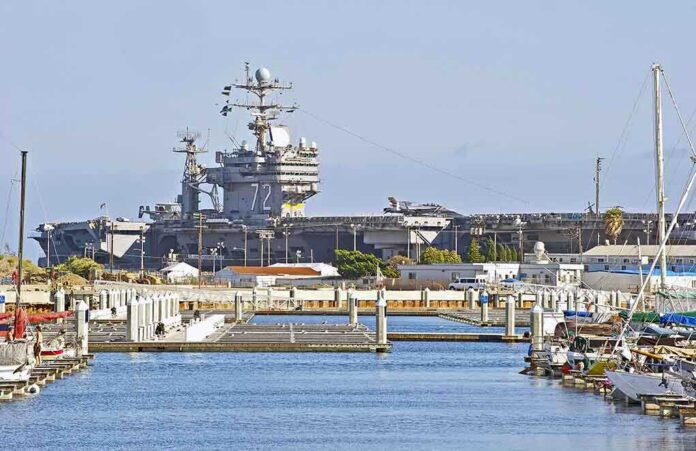
On November 16, 2025, the USS Gerald R. Ford, the crown jewel of US naval engineering, entered the Caribbean Sea, trailed by a flotilla of destroyers and supply ships. This was not a routine voyage. The Pentagon designated the mission as a counternarcotics push, but the scale and proximity left little doubt: this was a flex directed at Nicolás Maduro’s regime and its foreign patrons. It comes after months of maneuvers, flybys, and tense standoffs between US and Venezuelan forces, slowly ratcheting up the temperature in a region where the wrong move can spark a global flashpoint.
The Caribbean’s blue expanse is now divided by lines of warships, surveillance flights, and the watchful eyes of Moscow and Beijing. US Southern Command confirmed live-fire drills, and Venezuelan forces responded with their own sprawling exercises. Each side accuses the other of aggression while insisting on sovereignty and security. These are not empty gestures; the region’s oil arteries, trade routes, and fragile governments all hang in the balance.
Why This Buildup Is Different—and More Dangerous
This is not the first time Washington and Caracas have squared off at sea. But several factors make this deployment different, and more volatile. The Gerald R. Ford is not just any carrier; it is the most modern, heavily armed vessel afloat. Its presence signals both technological superiority and a willingness to escalate beyond past shows of force. The buildup is also larger, closer, and more persistent, with destroyers, air wings, and intelligence assets lingering near Venezuelan waters for weeks rather than days. Meanwhile, Venezuela has called up its Bolivarian militia, staged mock defenses of oil terminals, and sought public pledges of support from Russia, China, and Iran—all of whom have their own interests in seeing US influence checked in the hemisphere.
Diplomatic cables are flying almost as fast as the fighter jets overhead. US officials maintain the mission is about stopping drug smuggling, but their statements pointedly avoid ruling out more direct action. Maduro’s government, beset by economic crisis and international isolation, frames the standoff as a colonial assault and a rallying cry for sovereignty. As both sides dig in, even the smallest miscalculation—a flyby too close, a ship straying into contested waters—could spiral into something far more dangerous.
Regional and Global Repercussions of Military Escalation
The immediate risks are plain: a clash at sea, an accidental shootdown, or a targeted strike could ignite open hostilities. Such a conflict would threaten the livelihoods of millions, disrupt oil exports, and spark refugee flows throughout Latin America. For neighboring countries like Colombia and Caribbean island states, the prospect of a US-Venezuela conflict is deeply destabilizing—dragging them into a crisis not of their making but impossible to ignore.
Longer term, the confrontation sets a precedent for how the US projects power in its own hemisphere, and how rivals like Russia and China respond. Already, Russian aircraft have landed in Venezuela, and Chinese naval vessels have made port calls. If the standoff endures or escalates, it could reshape alliances, embolden other regimes to defy Washington, and destabilize the global oil market. Even the defense industry, shipping insurers, and humanitarian organizations are bracing for what could come, as the Caribbean becomes the new chessboard of great power competition.
What Experts Say—and What Comes Next
Military analysts widely agree: a full-scale US invasion of Venezuela is unlikely, but the risk of unintended escalation has never been higher. Some argue Washington is leveraging the threat of force to squeeze political concessions from Maduro, perhaps hoping for a negotiated exit. Others warn that the involvement of Russia and China could turn a regional crisis into an international one. Scholars of Latin American history note the mixed results of past US interventions, while security professionals caution that Maduro’s government, though isolated, has survived worse and will not fall easily.
American officials insist their intent is to deter trafficking and protect regional stability, but their actions suggest readiness for rapid escalation. Venezuelan leaders, for their part, vow to resist imperialism and mobilize every resource for defense. The world watches, holding its breath, as two adversaries test the limits of brinkmanship in a sea where the next move could change everything.
Sources:
Wikipedia: 2025 United States naval deployment in the Caribbean
CBS News: USS Gerald Ford aircraft carrier arrives in Caribbean
USNI News: USS Gerald R. Ford Enters Caribbean Sea
ABC News: US aircraft carrier arrives in Caribbean
Axios: Ford carrier adds to U.S. military buildup
Politico: US aircraft carrier arrives in the Caribbean