A New York mayor just told millions of people to sweat a little more at 78 degrees so the lights do not go out during a deadly heat wave.
Story Snapshot
- Mayor Zohran Mamdani declared a formal heat emergency as triple-digit heat and dangerous humidity hit New York City.
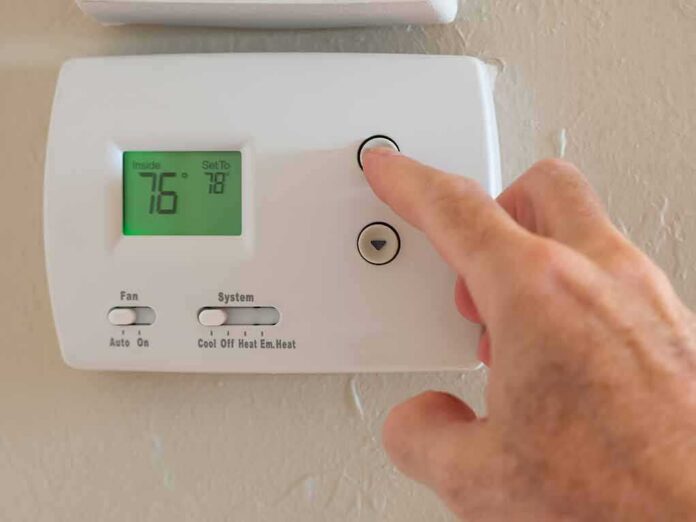
- He urged residents and businesses to set air conditioners to 78°F to cut strain on an already stressed power grid.
- He signed a first-of-its-kind executive order to shield roughly 1.4 million outdoor workers from extreme heat.
- The plan leans on cooling centers and “Beat the Heat” programs but offers no hard data proving 78°F is the magic number.
A city told to sweat for the grid
Mayor Zohran Mamdani did not mince words when he declared a heat emergency for New York City, warning that the heat index could surge into life-threatening territory and stay there through the July Fourth weekend. He framed the moment as a double crisis: a health threat for vulnerable people and a heavy risk for the city’s power grid as millions of air conditioners blast cold air at once. That is the backdrop for his simple but controversial ask: set the thermostat to 78 degrees.
During his press conference, Mamdani urged residents and business owners to raise their air conditioners to 78°F “to alleviate stress on our power grid.” He did not offer charts, studies, or utility statements to prove that exact number makes or breaks the grid. The message was more moral than technical: everyone should share a little discomfort now to avoid blackouts that could be deadly for seniors, people with chronic illness, and New Yorkers without reliable cooling at home.
The heat emergency playbook: cooling centers and worker rules
The mayor’s heat plan follows a familiar pattern seen across big American cities: declare an emergency, warn the public, and open up cool spaces fast. New York’s “Beat the Heat” program and related efforts focus on reducing exposure, opening cooling centers, and tracking who is most at risk. City health data show that on average about 500 New Yorkers die prematurely each summer due to hot weather, a statistic that gives blunt weight to his warnings. On paper, this is not theater; heat already kills.
To answer that reality, the city activated more than 200 cooling centers, from libraries and senior centers to mobile cooling buses parked near high-risk neighborhoods. These sites target people who cannot afford to run air conditioning nonstop or live in buildings that trap heat. Public health guidance from the city and national groups stresses that access to air conditioning is the single most effective way to cut heat deaths. So while the mayor asks offices to dial up to 78°F, the city works to make sure the poorest residents can get to air that is cool enough to keep them alive.
A first-of-its-kind executive order for workers
Mamdani’s most concrete move is not the thermostat pitch; it is his executive order on worker protection. The order directs a “whole-of-government” response to extreme heat and commands agencies to develop heat illness prevention plans, multilingual safety guidance, and new research on heat risks for workers. It focuses especially on the roughly 1.4 million New Yorkers who work outdoors in construction, delivery, street vending, and other jobs that cannot move inside when the sun turns brutal.
The order builds on existing “Beat the Heat” programs for residents but extends those ideas to labor, aligning with research that says cities must identify high-risk groups and tailor response plans to them. It also leans on basic conservative logic about work: nobody should have to choose between a paycheck and their health, and rules should be clear, not improvised at the job site. Requiring guidance in multiple languages reflects the reality that many front-line workers are immigrants who might otherwise miss critical warnings about heat illness and their right to breaks, shade, and water.
The 78-degree question: symbol, science, or soft social pressure?
Here is where the mayor’s plan slides from solid ground into softer sand. There is no public study in the record tying 78°F specifically to a measurable drop in grid stress in New York City. His press conference and executive order do not cite Con Edison, the New York power grid operator, or any engineer explaining why 78, not 75 or 80, is the crucial line. Municipal heat guides say cities should discourage “excess cooling in offices and commercial establishments” to protect the grid, but they stop short of naming a magic number.
That gap matters for anyone who values evidence over slogans. Many energy-saving campaigns, from federal advice pages to county “two-degree challenges,” push people to nudge thermostats higher in summer and lower in winter to cut demand. The concept is sound: air conditioning and heating drive about half of home energy use nationwide. But picking 78°F without clear local data risks looking like feel-good politics, not serious planning. Conservative common sense says: if government is going to tell businesses how to set the thermostat, it should show its math.
Politics, climate leadership, and the line between guidance and control
The thermostat ask dropped into a wider political storm. National critics have already painted Mamdani and similar urban progressives as socialists or even communists, warning that their climate and labor agendas signal more government control over private life. In that frame, “set your AC to 78” sounds less like neighborly advice and more like a test run for deeper mandates. Supporters, meanwhile, see a mayor trying to lead by example, echoing urban policy research that urges mayors to use their bully pulpit to teach citizens about heat danger and energy use.
From a conservative viewpoint, there is a useful line to draw. Government has a clear duty to warn people about lethal heat, keep the grid stable, and protect workers from being pushed until they collapse in the sun. Cooling centers, health alerts, and clear safety rules fit that duty. Voluntary thermostat guidance also fits, as long as it stays voluntary and is backed by honest data when available. The red flag would be any move from “please help your neighbors by choosing 78” to “we will punish you if you do not.” For now, Mamdani’s executive order walks that line: tough on employers who ignore basic heat safety, soft on residents who just want a cooler room.
Sources:
thegatewaypundit.com, nyc.gov, eenews.net, wcrinet.org, bluegreenalliance.org, youtube.com, x.com, abc7ny.com, instagram.com, nysclimateimpacts.org, pmc.ncbi.nlm.nih.gov, janewiseman.scholars.harvard.edu, sciencedirect.com, c40knowledgehub.org
© integritytimes.com 2026. All rights reserved.