A president who can turn a heckler into a punchline without missing a beat is executing one of the oldest tricks in the campaign playbook — and Donald Trump has spent a decade refining it into something like a signature move.
Key Points
- Trump was interrupted by hecklers while campaigning in Myrtle Beach, South Carolina, on August 21, 2026, for Senate candidate Darline Graham
- One protester wore a shirt reading “Kill Your Local Pedophile” and was escorted out by security along with a second demonstrator
- Trump dismissed the disruption with a quip that the protester was “going home to mom” to “get scolded,” and resumed his remarks almost immediately
- The rally was a closing push before Tuesday’s Republican Senate runoff between Graham and Rep. Ralph Norman
- The moment reflects a well-worn pattern in rally politics: brief disruptions get reframed by campaigns, critics, and media into competing narratives about composure versus disorder
What Happened in Myrtle Beach
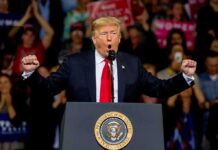
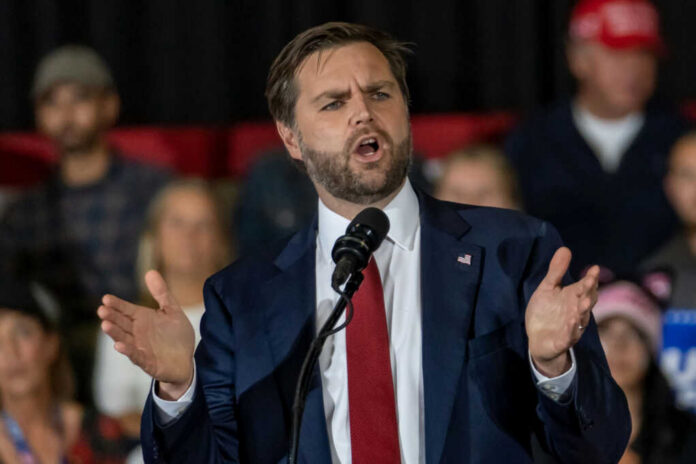
President Trump traveled to Myrtle Beach on Friday, August 21, 2026, to campaign for Darline Graham, a political newcomer seeking the U.S. Senate seat once held by her late brother. The rally, staged ahead of Tuesday’s Republican runoff between Graham and Representative Ralph Norman, was billed as a test of the White House’s remaining pull in a state Trump has carried decisively in three consecutive presidential elections. It did not go entirely to script. Partway through his remarks, hecklers began shouting, and according to the White House pool report, at least one protester had to be escorted out by police and convention-center staff.
Video and eyewitness accounts identify one of the ejected demonstrators as a man wearing a black T-shirt bearing the phrase “Kill Your Local Pedophile,” while a second protester wore a hat embroidered with an upside-down American flag — a symbol conventionally associated with signaling distress. The pair were removed without serious incident as the crowd reacted loudly to both the interruption and the ejection. Disruptions of this kind are not unusual at large outdoor or arena rallies, where security teams are trained to identify and extract agitators quickly precisely so the candidate can keep talking.
The Line Heard Round the Trail
What made the moment notable wasn’t the heckling itself but Trump’s response. Rather than engaging at length or letting the interruption derail his remarks, he delivered a single dismissive line, telling the crowd the departing protester was “going home to mom” and would “get scolded cuz mom is voting for us”. He barely broke stride before returning to his prepared remarks, and the crowd’s laughter and applause functioned as an immediate release valve for whatever tension the shouting had created. It is a technique Trump has used at rallies going back to his first presidential campaign: absorb the interruption, land a quick joke at the heckler’s expense, and use the crowd’s reaction to reassert control of the room within seconds.
Why the Senate Runoff Matters
The rally’s political stakes were real, even if the heckling briefly stole attention from them. Graham, running to fill her late brother’s Senate seat, faced Norman, a sitting congressman with an established statewide profile, in a runoff that both parties treated as an early signal for the November midterms. A presidential appearance this close to a runoff is a deliberate show of force — a signal to primary voters that the White House has picked a side and is willing to spend political capital defending it. Whether the disruption helped or hurt Graham’s closing argument is unknowable in any precise sense, but the rally accomplished its basic purpose: it put the president and his chosen candidate in front of cameras together in the campaign’s final days.
The Anatomy of a Heckler Moment
Political scientists who study rally coverage have long noted that the same sixty seconds of tape can be edited into entirely different stories depending on which frame a newsroom or social account chooses to apply. A protester ejected from a rally can be presented as evidence of a candidate’s composure under pressure, as proof of disorder and poor crowd discipline, or as a legitimate expression of dissent being silenced — and audiences tend to adopt whichever frame the coverage offers them rather than forming an independent judgment. That dynamic played out here in miniature: video clips of the same fifteen seconds circulated with captions ranging from straightforward wire-service description to more editorialized framing emphasizing either the shirt’s message or the president’s retort.
🚨 FACT CHECK: No, Trump Wasn't “Heckled by His Own Crowd” in South Carolina
A viral post is claiming President Trump was “heckled by his own crowd” at Friday night's Myrtle Beach rally.
That's a pretty misleading way to describe what happened.
Trump was interrupted by a… pic.twitter.com/WjZOIHu5xQ
— 🎹 Ames™ 🎹 (@Real_Ames) August 22, 2026
The Enduring Playbook
Heckler moments have shaped American campaign lore for as long as televised politics has existed, from Howard Dean’s ill-fated “scream” in 2004 to the 2016 cancellation of a Trump rally in Chicago after protester crowds grew too large for organizers to manage safely. What distinguishes a moment like Myrtle Beach from those cautionary tales is speed of recovery. A candidate who lets a heckler dictate the rally’s tempo cedes control of the narrative; a candidate who converts the interruption into a laugh line — as Trump has done reliably across a decade of rallies — turns a liability into a demonstration of exactly the unbothered confidence his supporters expect to see. That, more than the content of any single joke, is the actual skill being showcased, and it is why these moments keep recurring as a fixture of his public appearances rather than fading as isolated incidents.
Sources:
reuters.com, youtube.com, washingtontimes.com, x.com, uk.marketscreener.com, experts.umn.edu, en.wikipedia.org
© integritytimes.com 2026. All rights reserved.