
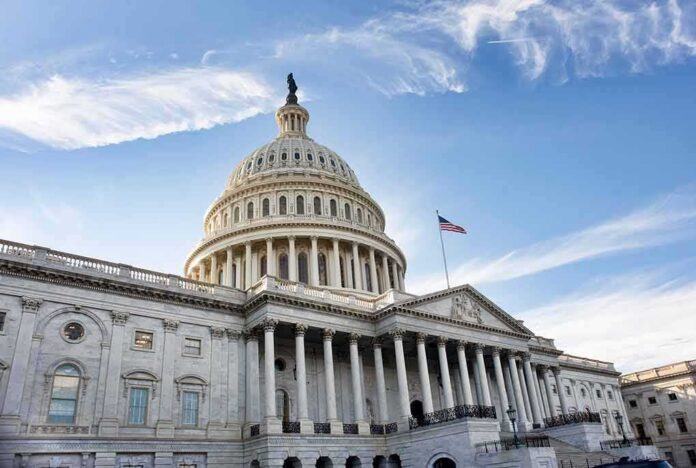
The fight for the House may run through Iowa, where four Republican-held seats face sharp crosswinds in the final stretch.
Story Snapshot
- Republicans defend all four Iowa U.S. House seats, with incumbents or nominees in place.
- Statewide polling shows a narrow Republican edge on the generic ballot among likely voters.
- Key race ratings shifted against Republicans in three competitive districts.
- District-level polls present mixed, sponsor-linked snapshots with tight margins.
Republicans Start With The Map And A Small Wind At Their Backs
Republicans entered the cycle holding all four U.S. House seats in Iowa, giving the party a head start on structure, staff, and local name recognition. A recent statewide survey by Marist found Republican congressional candidates ahead 50% to 47% among likely voters, a slim but real edge in a state that has leaned right in recent federal races. The same survey reported that most likely voters expected the Republican in their district to win, which often shapes money, morale, and media attention.
Republicans also touted the Iowa State Fair straw poll, which showed Republican candidates leading in all four congressional districts. That vote, while not scientific, tracks energy at big public events and can hint at volunteer strength for get-out-the-vote drives. Party strategists argue that incumbency plus a motivated base can carry close contests when turnout falls and ticket-splitting fades.
But The Referees Moved The Goalposts
The Cook Political Report shifted ratings against Republicans, moving Iowa’s 1st and 3rd Districts to lean Democratic and the 2nd to toss-up status. That public shift can affect donations and outside spending before votes are cast. The Des Moines Register coverage described how this negative movement combined with a tighter national picture for House control elevates the stakes in Iowa’s swing seats. In a thin-margin Congress, even one Iowa flip could decide committee gavels and policy direction.
District polls echoed the warning signs. One survey showed Democrat Christina Bohannan ahead of Republican Mariannette Miller-Meeks in the 1st District, while another found Democrat Lindsay James narrowly leading Republican Joe Mitchell in the 2nd. These snapshots varied by sponsor and method, but they pressured Republicans to defend rather than expand. Conservative readers should weigh that sponsor tilt, but also respect the pattern: when multiple tight polls appear, real risk exists down the stretch.
The 3rd District Math And The Turnout Test
Iowa’s 3rd District remains the fulcrum. Registered Republicans reportedly outnumber Democrats by about 16,000 voters there, a cushion that matters if turnout matches registration. A Cygnal poll for the Iowans for Tax Relief Foundation showed a narrow statewide generic Republican edge, consistent with a close environment where small shifts decide seats. The New York Times polling page for the 3rd reinforces that the race sits inside the margin where field work, early voting, and late-breaking independents can swing the outcome.
Republican confidence rests on fundamentals that appeal to conservative common sense: incumbents know their districts, organize year-round, and benefit when voters focus on taxes, energy, and security. Yet fundamentals do not vote; people do. Without proof of superior door-knocking, ballot chasing, and persuasion, those advantages can fade in a storm of negative ads and national narratives.
The Straw Poll Glow Meets Real-World Gravity
Secretary of State Paul Pate’s State Fair results gave Republicans eye-popping percentages across all four districts. Fairgoers, though, are not a random sample of likely November voters, and the totals involved hundreds, not tens of thousands. Treat the fair results as a read on enthusiasm, not a forecast. The better test comes from absentee-ballot requests, early-vote returns, and precinct-level turnout versus prior cycles, which campaigns can and should document for the public and the press.
The battle for the House could come down to just 10 seats, and Republicans are betting big on a state Trump won by double digits.
Iowa is emerging as an unexpected pressure point for the GOP, with three competitive congressional races and Fox News Power Rankings show Democrats… pic.twitter.com/Ex6qmofLo0
— Fox News (@FoxNews) October 20, 2026
Pressure rises because the national House fight is razor-thin. Republicans began with a narrow majority, and many analysts say only about 10 seats nationwide could decide control. That reality pulls national money into Iowa’s contested districts and raises the cost of late mistakes. For Republicans, the path is clear: lock down the base, bank early votes where legal and efficient, and close hard with independents who like divided government and expect competence over drama.
Sources:
facebook.com, desmoinesregister.com, sos.iowa.gov, maristpoll.marist.edu, nytimes.com, nbcnews.com
© integritytimes.com 2026. All rights reserved.