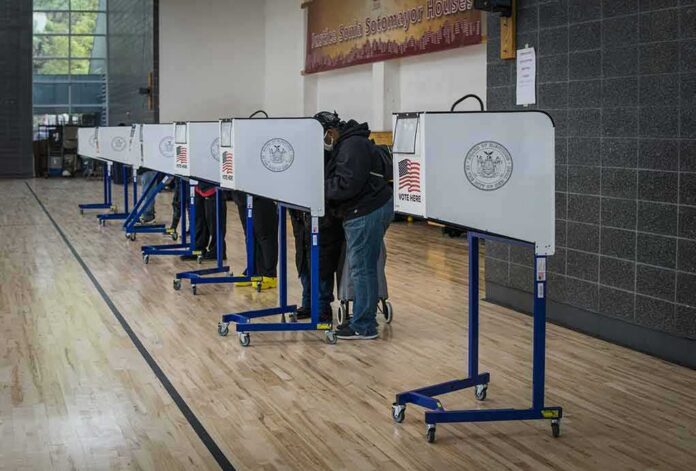
A cheeky “Sydney Sweeney” walk-in at a California polling place just turned a dry ballot measure into a gut-check on how we prove who we are to vote.
Story Snapshot
- Proposition 39 would add voter identification for in-person and mail ballots, with a free state voter ID on request.
- A viral ad uses a Sweeney impersonator and an AI likeness to spotlight impersonation risk at the polls.
- California now relies mostly on signature checks, not government ID, to verify voter identity.
- Opponents warn of ballot rejections and new barriers; polls show the measure trailing among likely voters.
What Proposition 39 Actually Requires
California’s Proposition 39 is not a slogan; it is a constitutional amendment with step-by-step rules. In-person voters would show a government-issued ID. Vote-by-mail voters would write the last four digits of a designated government ID number on the return envelope, which must match the registration record. The state would offer a free voter ID card for anyone who asks. These requirements would sit in statute and guide how counties process ballots.
The measure also directs election officials to verify citizenship when people register. It sets procedures for checking ballots that arrive without the matching identifying digits. It tells poll workers when to offer a provisional ballot and how to cure issues. Supporters say this closes a clear gap: the current system relies on signatures that can be hard to compare and easy to argue about after the fact. The new rules aim to add a simple, uniform check across counties.
The Ad That Made Everyone Look Up
The campaign leaned on humor to make a serious point. A man who resembles “Sydney Sweeney” walks into a polling place. A worker recognizes he is not her, yet he still walks out with a ballot. Later, an artificial-intelligence version of Sweeney struggles to vote. The bit is parody, not proof of real fraud, but it shows a basic risk in a signature-first system: a stranger can claim a name, and the stopgap depends on judgment in a busy room.
Critics will say ads are theater, not data. That is fair. But ads move attention to the core question: should California tie each ballot to a number only the real voter knows? On that narrow question, the policy aligns with common sense. You show ID for a beer, a flight, or a library card. You can get a free voter card if you need one. That design answers the “pay-to-vote” charge and keeps the focus on identity, not income.
How Current Law Works, And What Would Change
Today, most California voters prove identity with a signature. Workers compare the envelope or roster signature to the one on file. Disputes trigger cure steps, but mismatches still happen. Proposition 39 would add a new layer for every vote: show a card in person or write the last four digits of your chosen government number by mail. The state would still verify signatures, but the number match would be the primary gate for acceptance.
Opponents argue the change will reject valid ballots when people forget the digits or write them wrong. The official summaries say ballots lacking a match could be rejected if not cured in time. That is a real risk if counties do not give clear instructions, fast cure windows, and simple contact tools. Backers should publish detailed cure timelines, sample notices, and multilingual help lines now to prove the process will not eat lawful votes.
The Pushback, The Polls, And The Path Forward
Democratic leaders, civil-rights groups, and some election experts say California already has strong checks and that fraud is rare. They warn that new ID rules would fall hardest on poor and rural voters and people who move often. They add that personal data on envelopes could raise privacy fears. Governor Gavin Newsom frames Proposition 39 as a ploy to make voting harder and to toss valid ballots. Recent polling shows more likely voters oppose the measure than support it.
'Sydney Sweeney' Makes the Case for Voter ID in California in Brilliant Adhttps://t.co/QmB9Z3byqx
— RedState (@RedState) October 21, 2026
Supporters have a cleaner case when they stick to first principles: one voter, one verified ballot, no fee to prove who you are. The text delivers that. The weak spot is execution. Voters want to know how fast they get the free card, what documents they need, how seniors or people with disabilities get help, what happens if numbers do not match, and how many ballots could be cured in time. Publishing those answers, with county-by-county pilots, would calm doubts.
Sources:
sos.ca.gov, lao.ca.gov, quickguidetoprops.sos.ca.gov, igs.berkeley.edu, politico.com, democracydocket.com, latimes.com
© integritytimes.com 2026. All rights reserved.