President Trump told a room full of first responders he wants anyone who murders a firefighter to face the death penalty.
Quick Take
- Trump made the call at a White House Rose Garden luncheon on October 15, 2026, directly addressing Attorney General Todd Blanche.
- He said he wants the Department of Justice to pursue capital punishment in firefighter murder cases.
- Trump argued the threat of execution would make such shootings an “ancient crime” that quickly stops happening.
- Federal law still requires a specific federal offense and legal grounds before the death penalty can apply, so not every case would qualify.
What Trump Said And To Whom He Said It
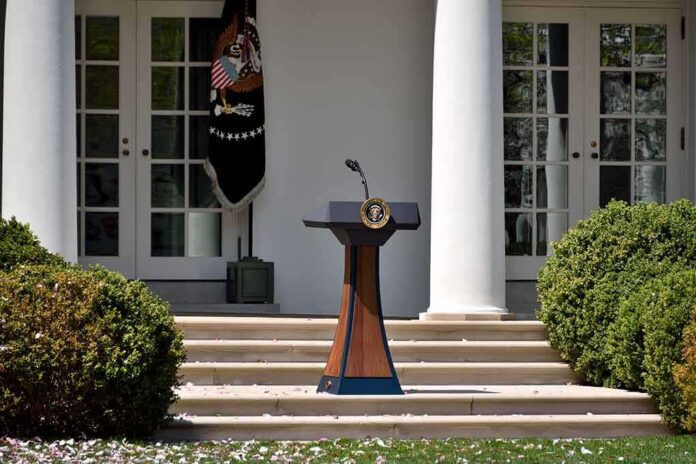
Trump delivered the remark during a Rose Garden lunch honoring first responders. Describing a scenario of a firefighter climbing a ladder into danger, he said: “Anybody that murders a firefighter, going up a ladder, and they shoot him… Death penalty, Todd.” He aimed the comment squarely at Attorney General Todd Blanche, turning a public statement into what sounded like a direct order.
Reporters at the event and outlets covering it afterward described Trump as directing the Department of Justice to pursue capital punishment for anyone who kills a firefighter. That framing moved the comment beyond a passing line and into the territory of a declared prosecutorial priority.
The Reasoning Behind The Push
Trump tied his proposal to deterrence. He suggested that shootings targeting firefighters would quickly stop if killers knew execution was on the table, calling it a crime that would become essentially extinct. He did not cite a study or data point to back up that claim, leaning instead on the argument that harsh punishment changes behavior.
That argument fits a familiar pattern in American politics. High-profile killings of police officers, firefighters, or children routinely spark calls for tougher categorical punishment tied to the victim’s role. Federal law already treats capital cases narrowly, requiring a qualifying federal offense and specific aggravating factors, not just the victim’s job title.
Why This Builds On Existing Support For Firefighters
Trump’s comment did not arrive in a vacuum. In December 2025, he signed the Honoring Our Fallen Heroes Act as part of the National Defense Authorization Act. That law expanded Public Safety Officers’ Benefits for firefighters sickened by job-related cancers, treating those illnesses as line-of-duty deaths. Lawmakers from both parties praised the bipartisan bill when it passed.
Seen together, the cancer benefits law and the death penalty proposal paint a consistent picture. The administration has moved more than once to tie policy directly to protecting and honoring firefighters, treating their safety as a distinct federal priority rather than folding it into generic crime policy.
The Legal Limits Standing Between Words And Outcome
Turning Trump’s statement into actual executions is not automatic. Federal capital prosecution requires the case to fall under federal jurisdiction and an applicable statute that authorizes the death penalty. Many killings, including attacks on firefighters, get prosecuted under state law instead, where state statutes and state death penalty rules apply.
Justice Department protocol already requires federal prosecutors to run any case eligible for the death penalty through a centralized review process, regardless of whether local prosecutors want to seek it. That means Attorney General Blanche and career Justice Department attorneys, not the president alone, control whether a specific indictment ends up seeking execution.
States also vary widely. Some have no death penalty on the books at all, meaning a federal push cannot force capital punishment into every courtroom nationwide. Any case prosecuted at the state level would answer to that state’s own laws, not a presidential directive.
What Comes Next For This Proposal
No firefighter murder case has yet been identified as a test of this policy. There is no confirmed indictment, sentencing memo, or specific defendant tied to Trump’s statement so far. The proposal remains a stated priority rather than a documented legal action, and its real-world impact will depend on how Justice Department prosecutors apply it case by case.
What is clear is the message Trump sent to firefighters and their families: their lives carry enough weight in his administration to warrant the harshest possible punishment for anyone who takes them. Whether courts and state laws ultimately deliver that outcome in any individual case is the next chapter still being written.
TRUMP: Death penalty for anyone who kills a firefighter. At a Rose Garden luncheon, he said he directed AG Todd Blanche to pursue it, and vowed the same for cop killers: "We're bringing the death penalty back." What do you think? #RealUSAStories #Trump pic.twitter.com/oMSWdPbU3N
— Real USA Stories (@RealUsaStories) October 16, 2026
For now, the proposal stands as a clear statement of intent from the Oval Office, paired with a real legislative record on firefighter benefits that suggests this is not an isolated talking point.
Sources:
ap7am.com, tommyxtopher.substack.com, iaff.org, usatoday.com, cmsapi.theepochtimes.com, ntrl.ntis.gov
© integritytimes.com 2026. All rights reserved.