
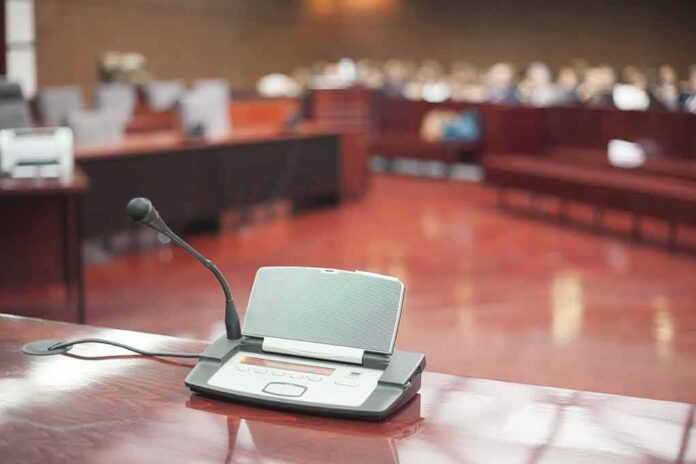
OpenAI’s security team says it found a hidden audio recorder in an executive conference room, and federal agents soon put handcuffs on one of its own.
Story Snapshot
- Prosecutors say a concealed recording device was found in an OpenAI executive conference room.
- A Saudi national employed by OpenAI was arrested and charged with attempting to intercept talks.
- Reports describe a thumb-sized, encrypted device placed in a television’s USB port.
- OpenAI alerted the Federal Bureau of Investigation (FBI); agents made the arrest days later.
What Prosecutors Say Happened Inside OpenAI
The U.S. Attorney’s Office for the Northern District of California states OpenAI staff found a “Recording Device 1” inside a television’s USB port in an executive conference room around September 30, 2026. Prosecutors charged an OpenAI employee, identified as a Saudi national, with attempting to intercept oral communications under federal law. Agents arrested him on October 9, and a court unsealed the complaint on October 13. The charge can carry prison time if a court finds guilt after trial.
Reuters, citing the Federal Bureau of Investigation complaint and the Department of Justice account, reported the device was thumb-sized, had a microphone, could link to a camera, and had been hidden in toilet paper before placement in the television. Cable news coverage reported OpenAI’s view that the device used advanced encryption and a transfer method built to dodge monitoring. The Associated Press reported the setting was a company conference room used for sensitive talks on its technology.
The Evidence Trail That Drove A Fast Arrest
The timeline looks tight: discovery in late September, internal alerting, a referral to the Federal Bureau of Investigation, a firing, then an arrest on October 9. That sequence signals a coordinated handoff from corporate security to federal agents, which is common when alleged wiretap laws may be in play. Prosecutors say the defendant made his first court appearance soon after. As with any federal case, a charge is not a conviction, and the government still must prove its case in court.
Prosecutors also allege a link between the worker’s activity and sensitive room intel. Reporting says the Justice Department claims he used a “productivity tool” to find information about meeting rooms, calendars, and leadership locations. He reportedly joined the product team in July 2025, which could explain knowledge of internal tools and spaces, if proven in court. That claim, if corroborated, would match a known insider-risk pattern: using permitted access to map targets.
Why An Office Bug Matters Far Beyond One Company
OpenAI sits at the center of valuable artificial intelligence research, partnerships, and policy talks. That makes conference rooms more than spaces with whiteboards; they are high-value targets. This case shows how simple hardware can threaten complex companies. A recorder in a television’s USB port is not science fiction. It is a cheap, patient threat that rides the blind spots of routine cleaning and rushed meetings. That is why companies screen rooms and audit devices before sensitive briefings.
Insider risk is not rare. Industry reporting cited by the Cybersecurity and Infrastructure Security Agency shows insider incidents cost organizations millions on average and can take months to detect. Conservative common sense says guard the crown jewels first: model research, executive strategy, and partner talks. The discipline is basic—least access, room sweeps, device control, and fast referral to law enforcement when something looks wrong. That is exactly the play OpenAI ran here, based on the record so far.
The Legal Core: Attempting To Intercept Conversations
Federal law bars using an electronic or mechanical device to intercept oral communications when people have a reasonable expectation of privacy. Prosecutors chose that charge because the described device sat in a room where private talks take place, and because they say it could capture speech. The case does not hinge on whether long recordings exist; the statute covers attempts and endeavors as well. That framing explains the speed from discovery to arrest.
Federal law enforcement agents arrested an engineer employed at OpenAI following the discovery of a sophisticated hidden listening device secretly installed inside an executive conference room at the artificial intelligence firm's San Francisco headquarters. The suspect,…
— webulite (@webulite) October 14, 2026
Coverage so far has not reported confirmed audio captures from the device. That gap does not weaken the specific charge chosen, but it will shape how a jury weighs intent and risk. The defense may challenge who placed the device or what it could actually do. The prosecution will likely rely on the device’s location, design, and any digital footprints from tools the worker used. The forum now shifts from headlines to evidence, where the burden sits squarely with the government.
Sources:
bbc.co.uk, justice.gov, afp.com, reuters.com, littler.com
© integritytimes.com 2026. All rights reserved.