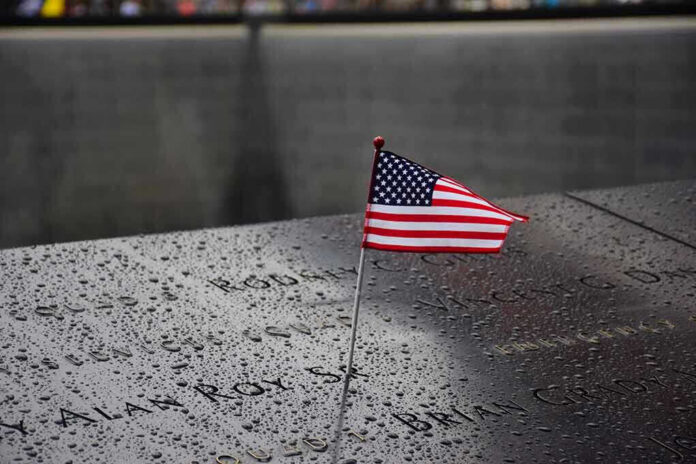
A red spray-painted slogan cut across the engraved names at the 9/11 Memorial—turning a sacred roll call into a billboard for a political cause.
Story Snapshot
- Police say the message “just stop killing kids” and a linked website were sprayed across victim names.
- Officers arrested a 31-year-old man after surveillance and witness accounts identified him at the scene.
- The 9/11 Memorial called the site sacred and said staff restored the panels the same day.
- Reports cite more than $2,550 in damage and criminal mischief and graffiti charges.
What Happened At Ground Zero And Why It Landed Like A Punch
Police and witnesses reported red paint across the North Pool panels at the 9/11 Memorial around late afternoon. The message included the words “just stop killing kids” and a website with the same phrase, which tied the act to a gun-regulation push. Officers said the suspect acknowledged his role. Media outlets ran the images fast, because the setting does the talking. A political plea placed over the names of murder victims reads as a moral trespass before anyone debates policy.
The 9/11 Memorial and Museum called the site a sacred space that honors 2,983 people killed in the 2001 and 1993 attacks. The institution said security and law enforcement ended the incident and staff restored the site to its commemorative state the same day. That statement carried weight because it centers those who died, not the protester. Police sources cited more than $2,550 in damage and described the markings as graffiti over bronze name panels.
The Slogan, The Strategy, And The Missing Specifics
The message was tight and built for search: a short moral claim and a matching website. That is a modern protest play. It uses shock, a viral image, and a clear digital path to more content. Reports named the suspect as a gun-regulation activist and tied him to the website. But the record so far shows no defined policy ask—no bill, no measure, no stated target. The tactic drove attention, but attention is not persuasion, and it often backfires when it hijacks grief spaces.
Coverage focused on the memorial, the names, and the arrest. That balance was predictable. When protest enters a space built for mourning, the space wins the frame. The public sees damage before it hears argument. Even supporters of tougher gun laws can recoil at that venue choice. That is the risk curve of expressive vandalism: high awareness, low sympathy. The best-case outcome is a loud day. The worst-case outcome is a hardening of opposition and a courtroom date.
Law, Order, And The Conservative Reading Of The Facts
Police charged the suspect with criminal mischief and graffiti-related offenses. Those are not speech crimes; they are property crimes. Free speech in America protects ideas, even ugly ones. It does not grant a right to paint over a memorial. That is where common sense meets civic duty. A society that cannot protect a place of mourning cannot protect much. The facts as reported support that view: overt markings, public time, clear intent to be seen, real repair costs.
The 9/11 Memorial’s language about a sacred site is not mere branding. It is a signal of shared norms that hold us together. You honor the dead by keeping faith with the living who grieve them. Spray paint across names breaks that faith. Critics call the act desecration because it used the memory of the murdered as a canvas for a separate cause. You can debate guns every day in a free country. You do not get to claim the names of the fallen to make your case.
What This Episode Teaches About Protest That Works
Graffiti can spread fast because a shocking image travels. Scholars who study protest media describe how such acts move from brick to screen to mainstream, gaining speed as each layer reacts. That loop can set the agenda for a moment, but it rarely builds trust. Trust grows when a movement shows respect for places of shared meaning. If you want to win hard arguments, you stand where the public sees dignity, not where it sees damage.
I don't understand why progressive protest via vandalism? And at the 9/11 Memorial? This is the exact opposite approach of MLK, etc. https://t.co/16iPSmycqG
— Anthony Bradley (@drantbradley) October 28, 2026
Public pressure rises when tactics match the gravity of the issue and the venue. Parents who fear school shootings deserve a focused, specific plan. Policy moves when advocates tie goals to facts, name the lawmakers, and show their work. This incident showed none of that in the reporting so far. It delivered a billboard painted on grief. It delivered handcuffs and a cleaning crew. It did not deliver a step toward safety. The lesson is simple: respect first, then persuade.
Sources:
twitchy.com, nydailynews.com, dailymail.com, cbsnews.com
© integritytimes.com 2026. All rights reserved.