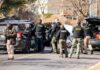

Agents say a man with weapons and a fake security story showed up twice as crews set the shield around President Trump’s Los Angeles golf course.
Story Snapshot
- Deputies say the man filmed security planning, then returned claiming government duty.
- A loaded pistol, ammo, and gear were seized from his car and home, prosecutors say.
- Federal charges followed, tied to the security advance for Trump’s visit.
- A judge later sent the case to mental health court after a fitness review.
What Investigators Say Happened On The Ground
Los Angeles County deputies first saw Jeanine John Taele roaming Trump National Golf Club in Rancho Palos Verdes as security teams set up before the president’s arrival. Witness accounts in police reporting say he wore an earpiece and took photos and video of the planning activity. Deputies detained him after a return visit, where he allegedly claimed State Department work and admitted a loaded gun sat in his car, according to summaries of the law-enforcement account.
Deputies say they recovered a 9 millimeter pistol, a 16-round magazine, and ammunition tied to Taele. Reports also describe a “security protection agent” badge in his things. The badge’s origin has not been clarified in the public record shared so far. The picture painted by the arrest report is simple and serious: close-in filming of security layout, a false government cover story, and a ready-to-fire handgun nearby during a high-security event window.
Why Federal Prosecutors Stepped In
Federal prosecutors filed a criminal complaint that centers on a separate but weighty firearms count. The government charged possession of an unregistered short-barreled rifle. A search of Taele’s home reportedly found that rifle, along with body armor, ammunition, and notebooks with concerning notes, according to the complaint summaries in press accounts. Maximum prison time for the rifle charge was cited at up to ten years under federal law, signaling a serious posture.
The United States Secret Service publicly linked the federal case to “suspicious activity during the advance security planning” for Trump’s Los Angeles visit. That detail matters. Secret Service doctrine treats odd behavior near the bubble as a risk until cleared. That means filming choke points and claiming federal credentials will ring every alarm until agents verify identity, intent, and capability. Prosecutors appear to have judged the capability box checked once the short-barreled rifle entered the file.
The Knife’s Edge Between Suspicion And Proof
Public records and media summaries do not prove a motive. The strongest on-scene facts describe photographing, a false backstory, and weapons possession. Defense lawyers often argue that odd behavior and a gun do not equal a plot. The materials summarized so far also include name and age inconsistencies across outlets, which can muddy perception. Still, the charge sheet, the rifle allegation, and the timing around a presidential visit justify firm action under common-sense security standards.
Authorities had also been looking at Taele for a separate robbery case, which adds to the risk profile, though it does not prove intent at the golf course. A judge set strict pretrial terms, including a stay-away order from the club and a weapons ban, and set bail at a quarter million dollars. Those conditions match how courts treat potential danger while facts are sorted out under oath and with full evidence logs in hand.
Where The Case Stands Now
A later turn moved the matter into a different lane. A judge suspended the criminal case and sent Taele to mental health court after a pretrial evaluation found he was not competent to stand trial at that time. The public defender said it was too soon to say how mental health would shape any eventual defense. Competency rulings do not erase facts; they pause the process until the defendant can understand the case and help a lawyer mount a defense.
Americans deserve both safety and due process. The record shows fast, coordinated action when a stranger appeared to map security while armed. That lines up with how the Secret Service is trained to prevent harm, not only respond to it. The later competency finding shows the system can shift gears to address mental health while still preserving the government’s evidence for a future day in court. That balance is hard work. It is also how a serious country stays both safe and fair.
Sources:
facebook.com, upi.com, losangelescountypolitics.com, x.com
© integritytimes.com 2026. All rights reserved.