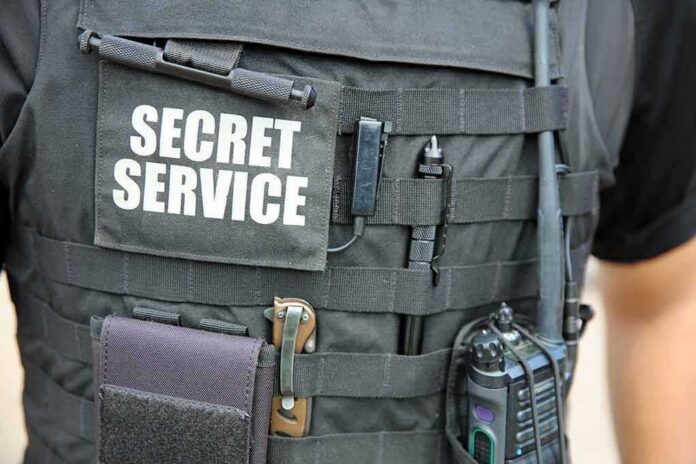
Three Secret Service communications officials, including the agency’s communications chief, were escorted out of headquarters and had their security clearances pulled amid a sensitive leak probe tied to presidential protection.
Story Highlights
- Secret Service confirmed three employees are on leave pending a misconduct review.
- Reports say FBI and Central Intelligence Agency are involved, signaling a high-stakes case.
- The dispute follows Trump’s covert plane swap during an Iran-linked threat window.
- Clearance suspensions show the service is locking down sensitive information fast.
What Happened Inside Secret Service Headquarters
Reporters learned Monday that three communications-office employees were removed from Secret Service headquarters and labeled “do not admit,” including Communications Chief Anthony Guglielmi, according to multiple outlets. The agency then confirmed the core action on the record. A spokesperson said three non-law-enforcement employees were placed on administrative leave during an Office of Professional Responsibility investigation into potential misconduct. This is a standard first step when an agency fears exposure of sensitive operations or information.
Several reports said the Federal Bureau of Investigation (FBI) and Central Intelligence Agency (CIA) are participating in the inquiry, which would point to a matter beyond routine human resources issues if accurate. That kind of interagency mix usually signals concern about classified intelligence handling or possible criminal exposure. The Secret Service did not label the matter a criminal probe in its statement. The agency framed it as an administrative review, which still allows parallel criminal referrals if facts warrant them.
The Security Backdrop: A Covert Presidential Plane Swap
This personnel action follows reporting on a secret flight swap that moved President Trump off his public aircraft after an Iranian-linked threat emerged during travel from Turkey to Britain. Accounts described a decoy operation where Air Force One acted as cover while the president flew on a different plane to deny targeting windows. Trump later said the Secret Service and military wanted him on a different plane because of a threat, confirming the protective trigger for the switch. These details put fresh focus on who knew what, and when.
Major outlets also reported that some intelligence officials had low confidence in parts of the threat stream, even as the Secret Service stepped up security. That split matters because protection does not wait for courtroom proof. Agents act on risk, speed, and duty of care. Conservative common sense says you err on the side of the protectee’s life. If an insider shared sensitive routing, timing, or methods during such a moment, that would raise red flags across the government.
Why Communications Staff Are Central To Sensitive Operations
Communications offices sit at the junction of operations and the public record. They handle movement details, timing windows, cover stories, and media coordination. During a deception plan, the seams between truth and necessary silence can be razor thin. A stray email or phone call can burn a route, a decoy, or a source. That is why clearances are not a perk; they are a promise. When leadership fears that promise was broken, they cut access first and ask questions second.
Clearance suspensions also reflect a known pattern in leak cases. Agencies often act fast with administrative tools to contain damage during early fact-finding. Outside reporting then races ahead with anonymous detail and big headlines. The Pentagon used similar steps in a 2025 leak sweep when multiple officials were put on leave as scope expanded. The approach buys time, limits exposure, and signals to staff that operational security beats office politics every day.
What To Watch Next
Expect a tight-lipped process. The Office of Professional Responsibility will collect devices, check logs, and pull message traffic. If the FBI or CIA found foreign nexus or classified spillage, they will firm up chain-of-custody and intent. Congress may ask for briefings, but real answers often stay behind closed doors until internal reviews end. One line remains clear: conduct that risks a protectee’s safety will not be excused as gossip or spin when lives are on the line.
Sources:
thegatewaypundit.com, yahoo.com, washingtonpost.com, newsbreak.com, nytimes.com, democracynow.org, bbc.com, aa.com.tr
© integritytimes.com 2026. All rights reserved.