
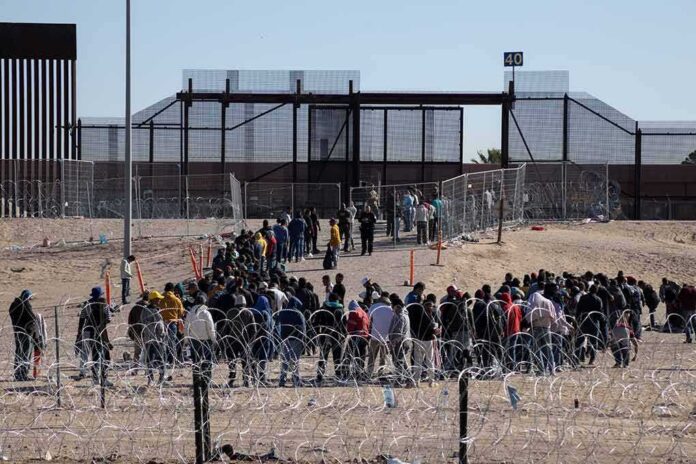
Almost 50,000 people flooded into a tiny Spanish city in Africa in one day, turning Europe’s border into a live stress test of how much chaos its leaders are willing to tolerate.
Story Snapshot
- About 49,000 migrants rushed into Spain’s enclave of Ceuta from Morocco in 24 hours, an unprecedented surge.
- Local authorities begged Madrid for a national emergency and the army, calling the situation “absolute chaos.”
- Spain’s reception system collapsed under the numbers, and at least 18–19 people died during the crossing.
- The incident exposed weak border controls, legal loopholes, and deep cracks inside the European Union over migration.
A tiny enclave suddenly faces a human wave
Ceuta is a six-mile-long Spanish territory on the African coast, wedged against Morocco and technically part of the European Union’s external border. In the space of roughly 24 hours, Spain’s Interior Ministry and national media estimated that about 49,000 migrants entered Ceuta by sea and land, a number equal to more than half the city’s population. Some reports from Spanish and international outlets put the wider surge at 50,000 to 60,000 over Thursday and Friday. Whatever the exact count, officials agreed it was the largest single-day crossing Spain has ever recorded into the enclave.
Most of the migrants were young Moroccan men and teenagers, with some reports mentioning people from sub-Saharan Africa mixed into the crowds. Many swam around breakwaters at Tarajal beach or used inflatable devices to reach shore, while others rushed through gates or climbed parts of the border fence when Moroccan security presence at key points thinned or disappeared. Spanish media described throngs of people pouring onto the beaches and running into city streets, overwhelming local police and border guards as they tried to keep order.
Border control breaks down and Spain scrambles
As the numbers rose, Ceuta’s regional president Juan Jesús Vivas warned that the enclave’s reception system was “overwhelmed” and at risk of collapse. Police and local officials reported thousands of new arrivals sleeping outdoors due to a lack of shelter space. Spanish authorities responded by deploying troops, armoured vehicles, naval units, and military divers to back up the Civil Guard, patrol the coastline, and secure the most exposed fence sections. Local leaders publicly urged Madrid to declare a national emergency, and national broadcasters framed the situation as the most serious border crisis since a major Ceuta incident in 2021.
The human cost rose quickly. Spain’s interior minister and other officials confirmed that at least 18 to 19 people drowned or died in coastal waters while trying to reach the enclave, with some estimates later mentioning “around three dozen” deaths linked to the wider surge. Images and video showed exhausted men dragged from the surf and others clinging to flotation devices, underlining how reckless the crossing was. According to Spain’s Interior Ministry and national broadcasters, many of those who made it into Ceuta had risked strong currents and long swims in the dark to get there.
Morocco’s role and the return flow
Spanish state media and Reuters reported that during some of the largest rushes, Moroccan auxiliary forces near the fence stepped back or were not visible, allowing hundreds of youths to scale barriers and run through border areas with little resistance. That observation fueled claims in Spain and parts of the European Union that lax Moroccan enforcement, deliberate or not, helped trigger the chaos. At the same time, recent years have seen Moroccan authorities block tens of thousands of attempts to reach Ceuta, showing that the country can clamp down hard when it chooses.
By the following day, Spain and Morocco moved in the opposite direction, tightening control and beginning to reverse the flow. Reinforced fence lines, water cannon trucks, and riot police on the Moroccan side started pushing back crowds near the gates. Spain’s Interior Ministry and several outlets said that roughly half of those who had crossed, about 25,000 people, had already returned to Morocco by Friday afternoon, many citing hunger and the lack of shelter as reasons for heading back. Ceuta’s streets, which had seen looting of some shops and reported attempts to enter homes, slowly began to calm as security forces regained control.
Europe’s migration fault lines widen
The scale of the Ceuta surge did more than strain one small city; it lit up long-running weaknesses in European migration policy. Spain’s interior ministry itself admitted that legal loopholes near Ceuta had been exploited, with large groups using gaps at the shoreline and the complexities of rapid mass arrivals to overwhelm border security. Tens of thousands of undocumented migrants crossing a single land frontier in one day forced Spain to lean on military tools to plug holes that better planning and tougher enforcement should have addressed earlier.
Migrant deaths rise to 41 in massive crossing into Spain's Ceuta from Morocco; over 37,500 migrants returned to Morocco voluntarily, say officials #España #CeutaEsEspaña https://t.co/7uAx1fDmzo pic.twitter.com/B2DvJf9D2W
— Gulf Today (@gulftoday) July 31, 2026
For many conservatives in Europe and abroad, the episode looked less like a “spontaneous movement of people” and more like a stress test of Europe’s will to defend its borders. When a city of 84,000 residents sees 50,000 migrants surge through its gates overnight, that is not a manageable inflow; it is a shock to basic order and security. From a common-sense, sovereignty-first view, the lesson is clear: if a nation does not control who enters, someone else will decide that for them, whether that is trafficking gangs, foreign security forces that step aside, or social media campaigns that rally the next rush.
Sources:
pjmedia.com, reuters.com, en.wikipedia.org, euronews.com, lemonde.fr, visahq.com, nypost.com, nytimes.com, abc.net.au, washingtonpost.com, facebook.com, cbc.ca, english.elpais.com, bbc.com, theguardian.com
© integritytimes.com 2026. All rights reserved.