
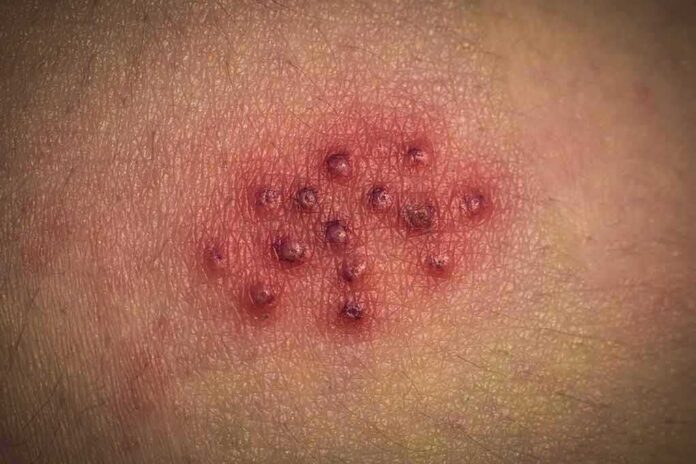
For the first time since the year 2000, measles is officially back home in America, not just visiting from overseas.
Quick Take
- The Pan American Health Organization (PAHO) declared on November 17, 2026 that the United States lost its measles elimination status.
- PAHO says the same measles strain circulated inside the country for 12 straight months, starting January 20, 2025.
- The Centers for Disease Control and Prevention (CDC) reported 5,412 confirmed U.S. measles cases as of November 12, 2026.
- Bolivia and Mexico lost elimination status in the same announcement, both tied to sustained outbreaks.
What PAHO Actually Decided
PAHO’s Regional Monitoring and Re-Verification Commission met November 10 through 13, 2026, to review measles data from 47 countries and territories across the Americas. After examining the evidence, the commission concluded that endemic transmission had returned in Bolivia, Mexico, and the United States. PAHO Director Dr. Jarbas Barbosa accepted that recommendation, and all three nations officially lost their elimination status.
The rule behind the decision is specific, not vague. PAHO defines re-established endemic transmission as the same measles genotype and lineage spreading without interruption for 12 months or longer inside one country. That is a technical, lab-driven standard, not a political judgment call. For the United States, PAHO pinpointed the outbreak’s start as January 20, 2025, with the 12-month threshold hit exactly one year later, on January 20, 2026.
The Numbers Behind The Decision
CDC’s own surveillance backs up the scale of the problem. As of November 12, 2026, the agency counted 5,412 confirmed measles cases nationwide for the year. That is the backdrop against which PAHO’s scientists reviewed genetic and case-tracking evidence submitted directly by CDC, the kind of data needed to prove the virus never stopped spreading on its own.
Reuters reported that PAHO’s evaluation relied on epidemiological and laboratory evidence CDC submitted, used specifically to determine whether one strain had circulated without a break for a full year. That submission process matters. This was not PAHO guessing from headlines. It was a formal review of data the United States government itself provided.
Why Elimination Status Exists At All
The United States first earned measles elimination status in 2000, meaning the virus no longer spread on its own here. Imported cases still happened, brought in by travelers, but they used to fizzle out instead of catching fire. Between 2001 and 2019, the country logged 3,873 cases and 747 international importations yet kept its status, because no chain ever lasted a full year. That streak just ended.
A Pattern Playing Out Across The Region
The United States is not alone, and that context matters. Canada lost its own regional elimination status in November 2025 after sustained transmission there. Now Bolivia and Mexico join the United States in the same November 2026 announcement. PAHO is not singling out one country; it is documenting a broader erosion of measles control across the Americas, and urging every nation in the region to close vaccination gaps before more ground is lost.
The Political Reaction Breaks Down Predictably
Within hours of the announcement, reaction split along familiar lines. Senator Patty Murray publicly criticized Health Secretary Robert F. Kennedy Jr. over the loss, while medical groups like the Pennsylvania Medical Society called it a significant public health setback. Social media filled with partisan blame aimed at the current administration. None of that commentary changes PAHO’s underlying laboratory finding, but it shows how fast a scientific determination can turn into a political football.
PAMED recognizes the United States’ loss of measles elimination status as a significant public health setback.
This loss of measles-elimination status by PAHO reflects the growing impact of measles outbreaks across the country.
For additional support: https://t.co/MG5TAGsrza. pic.twitter.com/9YgxWpzyRt
— Pennsylvania Medical Society (@PAMEDSociety) November 17, 2026
Strip away the finger-pointing and the core fact stands on its own. A respected international health body reviewed a full year of American case data and lab evidence and concluded the virus took root here again. Conservative voters who value clear-eyed accountability should welcome that PAHO used hard genetic evidence, not headlines, to reach this conclusion, and should expect the same rigor from U.S. health agencies going forward.
What Comes Next For American Families
Losing elimination status does not mean measles is suddenly everywhere, but it does mean the virus found a foothold and kept spreading for a full year without dying out. CDC and state health departments now face the harder job of proving, through vaccination pushes and outbreak control, that this was a temporary slip rather than a new normal. PAHO has made clear the path back runs through closing immunization gaps, not through disputing the data.
Sources:
youtube.com, paho.org, detroitnews.com
© integritytimes.com 2026. All rights reserved.