
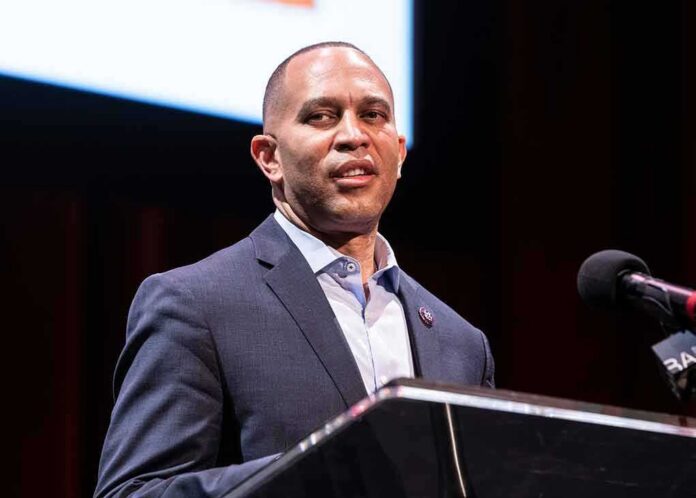
Hakeem Jeffries’s quick nod set off a fight over what Democrats would actually do about third-country deportations.
Story Snapshot
- A short exchange shows Jeffries nodding when asked about bringing deportees back.
- Democrats have attacked the policy’s cost and secrecy, and opposed new enforcement funds.
- A federal appeals court found due-process flaws in the transfer system.
- DHS defends third-country removals as a needed public-safety tool.
What the clip shows, what it does not
A reporter asked Hakeem Jeffries if Democrats would bring back people deported to third countries like those in Africa. Jeffries appeared to nod yes and said, “We do,” before describing the current system as extreme and inhumane, and calling for “fair” and “humane” enforcement. A repost of the exchange underscores that he did not say the word “yes,” which fuels debate about intent and scope. The clip alone does not prove a plan to repatriate all deportees.
Democratic leaders have criticized the program’s impact and pushed against more money for enforcement. Jeffries opposed a House reconciliation push that steered about $70 billion to immigration enforcement, signaling a broader stance against expanding the current system. That public position lines up with a party narrative that stresses due process, oversight, and restraint. But opposition to funding does not equal a formal promise to fly people back.
The legal pressure that changed the stakes
Human Rights Watch detailed court rulings that require better notice and a real chance to contest transfers based on fear of persecution or torture. National Public Radio reported that a federal appeals court found the third-country process violated due process because migrants lacked sufficient notice and a chance to explain risk, a ruling that reshaped what the government must do next. These rulings push agencies toward more transparency and hearings, but they do not create a blanket order to return every person already transferred.
Critics also target the price tag and opaque deals behind the flights. The Africa Report quoted Senator Jeanne Shaheen calling the reported $410 million effort “costly, wasteful and poorly monitored,” pressing for sunlight on how and why transfers occur. Those concerns draw attention to contracts, foreign agreements, and the absence of clear public metrics. Fiscal questions make any talk of large-scale returns even more controversial because they carry their own cost.
The case for third-country removals
Department of Homeland Security leaders defend third-country removals as a last-resort tool for hard cases. The agency’s top lawyer, James Percival, said the practice is essential when home countries refuse to take people back, when return is unsafe, or when logistics block removal to the country of origin. The Associated Press summarized the administration’s view: the tool applies to people with final orders who cannot go home for diplomatic or safety reasons. Congress’s research arm described a framework that leans on diplomatic assurances about safety from the receiving country.
🇺🇸✈️🌍 Deported to a country he'd never seen, then sent where a judge said he'd be in danger
📰 What happened
Moussa Diawara, 57, is from Mali and lived in the US for 25 years. He has no criminal record. He came to the US at 32 on a tourist visa and overstayed it. He married,… https://t.co/vrrkeTb39Q— Miss Lara B. 🏳️⚧️ (@RealLaraBridge) October 26, 2026
Supporters also say this tool reaches the hardest cases, including people accused of serious crimes, and keeps faith with court orders that bar return to a danger zone while still executing removal from the United States. The government says the State Department secures assurances that transferees will not face persecution or torture, and that migrants get notice before removal. Whether those assurances work in practice is a separate fight that courts and reporters have raised, which is why the legal pressure has grown.
So, would Democrats bring them back?
The brief Jeffries nod lives in a bigger fight over process, power, and cost. The on-camera moment hints at sympathy for remedies, but Democrats have not released a plan that orders mass repatriation of everyone sent to third countries. Their public record focuses on ending or reshaping the practice, adding hearings and guardrails, and blocking more money for rapid expansion. That agenda aligns with common-sense priorities: fix due process first, expose the spending, and test claims with oversight.
American conservative values prize the rule of law and clear limits. On the facts now, the strongest conservative read is simple: follow court rulings, confirm safety case by case, and stop blank checks for programs run in the dark. If Democrats want to go beyond hearings to physical returns, they should show the plan, the legal authority, the price tag, and how it avoids bringing back violent offenders. Voters deserve that clarity before anyone waves planes in.
Sources:
thegatewaypundit.com, fatelephant.com, theafricareport.com, npr.org, jeffries.house.gov, abcnews.com, usatoday.com, apnews.com, congress.gov, washingtonpost.com
© integritytimes.com 2026. All rights reserved.