
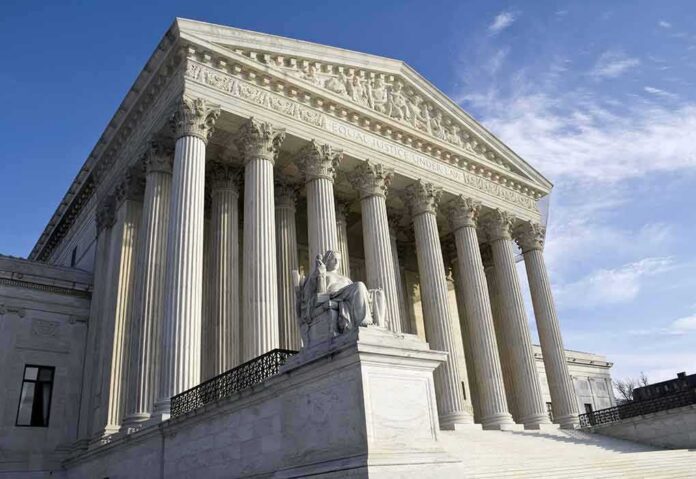
Justice Samuel Alito said he weighed retirement this year but chose to stay because he believes he still has work to do.
Story Snapshot
- Alito considered retiring but decided to remain on the Supreme Court, saying he can still contribute.
- He gave rare, extended on-camera interviews with CBS and Fox, tied to his upcoming book.
- He warned of a concerted effort to intimidate the Court and said justices work to ignore pressure.
- He said Senate control did not shape his decision about retirement timing.
What Alito Said About Retirement, Timing, and Duty
Justice Samuel Alito told CBS he thought about retiring earlier in 2026, as “someone at my age” must do each term, but decided to stay because he believes he can still make a contribution. He said some conservatives urged him to step down while Republicans control the Senate, but that was not part of his choice. That answer fits a simple rule most Americans respect: do the job if you can still do it well. He signaled he will revisit the question each year.
CBS said the sit-down was unusually extensive and personal. The network’s Jan Crawford interviewed him for several hours at a baseball field from his New Jersey childhood and inside the Supreme Court itself. For a justice who rarely opens up on camera, that setting matters. It showed a man thinking out loud about service, time, and legacy, not a politician gaming angles. The images and the length of the talk gave viewers a clearer feel for how he approaches hard calls.
Why Speak Now: A Book And A Broader Audience
CBS tied the interview to Alito’s first book, “So Ordered: An Originalist’s View of the Constitution, the Court and Our Country,” set for release this week. He also appeared on Fox News Sunday with Shannon Bream, discussing the Court’s toughest cases and his outlook on hot-button issues. The timing tracks with how justices sometimes step out to explain their work when interest peaks. A book offers a long-form case for his views; the interviews bring those ideas to a mass audience.
Fox and Agence France-Presse reported that Alito described a “concerted effort” by political actors to intimidate the Court, and that the justices try to ignore such pressure and do the job. That claim lines up with the last few years of sharp rhetoric around major rulings. The warning also rests on a common-sense point that conservatives stress: courts should not bend to mobs or campaigns. Law must outlast the news cycle, or it is not law at all.
How He Framed Independence And The Court’s Future
Alito’s comments put independence ahead of politics. He rebuffed suggestions to time an exit around Senate math and instead grounded his decision in ability and duty. That stance rejects a view of the Court as just another branch chasing votes. It also mirrors a conservative idea that institutions survive when leaders follow rules, not polls. He cast the Court’s future as tied to whether justices can decide cases free from fear, not whether critics cheer or boo.
CBS highlighted that the conversation reached beyond retirement to past rulings and the Court’s rough recent waters. That scope matters. It suggests he aimed to place his choices within a long arc—what originalism means, how major cases land, and why tone in public life affects the bench. The format—long, calm, specific—worked against the quick outrage loop. It invited people to judge arguments, not sound bites, even as the topic invites strong views.
What To Watch Next: Cases, Culture, And Candor
The substance now shifts back to cases. The Court’s docket will test Alito’s claim that pressure does not change outcomes. His book will give a fuller map of his method and may answer open questions from the broadcasts. Expect more claims about intimidation whenever a ruling divides the country; expect more calls for retirement timing to match party advantage. He set his marker against both. He said he will keep deciding, one term at a time, until he cannot add value.
Supreme Court Justice Samuel Alito talks retirement – The Horn News https://t.co/tr9tz1qgup via @ReadTheHornNews
— Terrie Lake (@terrielake) October 5, 2026
One practical takeaway stands out for readers who do not live and breathe court watching. You do not need to agree with every opinion to see the value in hearing a justice explain the work in plain terms. These interviews were rare for a reason, but they served a basic civic need. They let the country see a judge justify choices, accept scrutiny, and reject fear. That is not a small thing. For a court built on reasons, reasons still matter most.
Sources:
townhall.com, cbsnews.com, foxnews.com, afp.com
© integritytimes.com 2026. All rights reserved.