The United States yanked a dozen B-1 bombers out of Britain overnight because leaders judged the risk was real, immediate, and not worth gambling.
Story Snapshot
- The Pentagon confirmed every U.S. bomber at RAF Fairford returned to U.S. home bases.
- British police made terror-related arrests near the base and evacuated nearby homes.
- Britain’s prime minister said there were “strong indications” of an Iran link; Tehran denied it.
- Officials did not release the underlying intelligence supporting the suspected plot.
What Triggered The Sudden Exit From RAF Fairford
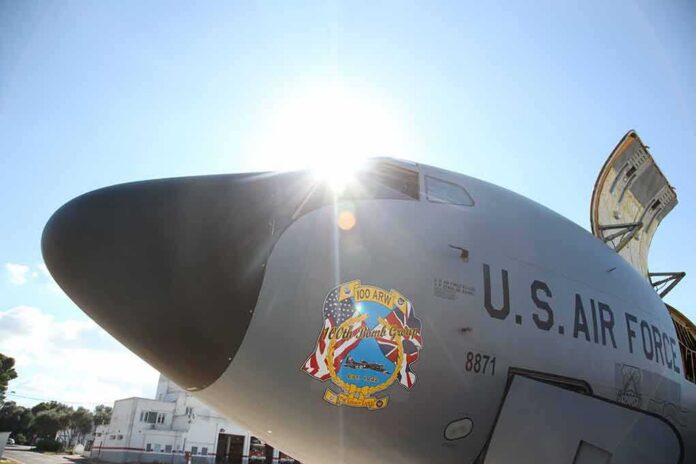
The Pentagon confirmed that all U.S. bombers deployed to Royal Air Force Fairford re-deployed to their home stations in the United States. Multiple outlets reported the force included 12 B-1 Lancers, and officials framed the move as a protection step while a suspected plot was probed. The withdrawal followed arrests near the base after reports of suspicious vehicles. British police labeled it a terror-related incident, and local leaders ordered evacuations of nearby homes.
Royal Air Force Fairford serves as a U.S.-run bomber hub. American crews use it to stage long-range missions and to surge presence in Europe and the Middle East. That mission set makes the base an obvious target for hostile states or proxies. When the threat picture shifts from background noise to a credible risk, commanders move aircraft. Metal and aircrews can be replaced; a loss on the ramp would be a strategic gift to an adversary.
The Iran Question And What We Actually Know
British Prime Minister Andy Burnham said there were strong indications that Iran played a part in the suspected plot. That claim set the political frame for a tense week and aligned with reporting that investigators weighed an Iranian motive as most likely. Tehran responded with a categorical denial and called the link “unfounded and malicious” propaganda. Both cannot be true, but only one side controls classified leads and sources at this stage.
The public record does not yet show the bridge from on-the-ground arrests to direct Iranian command. Police confirmed terror offenses under review and said the men remained under investigation. Reports noted that some suspects were released on bail. Officials did not publish intercepted messages, payment trails, or devices tying the group to an Iranian service or proxy. That silence is routine early in national-security cases, but it leaves citizens parsing official hints rather than hard exhibits.
Why The U.S. Moved Fast: Risk, Cost, And Deterrence
U.S. commanders weigh three things in a case like this. First, vulnerability: bombers on the ground are soft targets. Second, consequence: a single successful strike would carry huge human and strategic costs. Third, signaling: pulling aircraft denies an adversary a cheap win and shows that threats raise the price, not lower it. On that math, the rapid redeployment looks prudent. It protects crews, preserves deterrence, and buys time for investigators to close the attribution gap.
The evacuation of all 12 B-1 Lancer bombers from RAF Fairford was driven by fears of a plot against the base, according to NYT.
U.S. officials believe a branch of Iran's Islamic Revolutionary Guard Corps recruited UK nationals to attack the bombers and kill personnel.
The plan… pic.twitter.com/D5392XHaTG
— Comandante🎖️ (@commandante_) October 4, 2026
Some critics will argue that moving aircraft rewards fear. That view ignores how airpower works. Bombers are global; they do not need a specific British runway to hold targets at risk. The United States can surge from the mainland with tankers and allied overflight. Redeployment shifts the chessboard without giving up a piece. If the threat proves hollow, aircraft can return. If it proves real, they were not sitting still for a photo op that helps an enemy’s propaganda.
Sorting Claims From Proof In A Foggy First Week
Attribution in national-security cases builds in layers. Investigators form early judgments based on fragments, patterns, and prior behavior. Public statements often move before documents do. That gap can be frustrating, but it is also why healthy skepticism and patience matter. The prime minister’s phrasing—“strong indications”—is a signal, not a verdict. Iran’s denial is expected; hostile states rarely plead guilty on press release. The job now is to watch what evidence surfaces and what charges, if any, follow.
American conservative instincts line up with the facts so far: defend forces, do not wait for perfect proof when lives are at stake, and keep pressure on regimes that test the West. If later filings show a state hand, impose real costs on the sponsor, not only on foot soldiers. If the case points elsewhere, say so clearly and move assets back as threats ebb. Strength is not bluster; it is clarity, readiness, and the will to act fast and reverse fast as facts harden.
What To Watch Next
Watch for three markers. First, formal charges that describe devices, funding, or direction. Second, coordinated statements from British counterterror police and the United States Air Force that tighten the timeline from the arrests to the aircraft launch window. Third, any sanctions or expulsions that target named operatives or embassies. Those steps would shift this story from a tense weekend to a documented foreign-actor case with consequences that last beyond a news cycle.
Sources:
mediaite.com, aljazeera.com, bbc.com, cbc.ca
© integritytimes.com 2026. All rights reserved.