
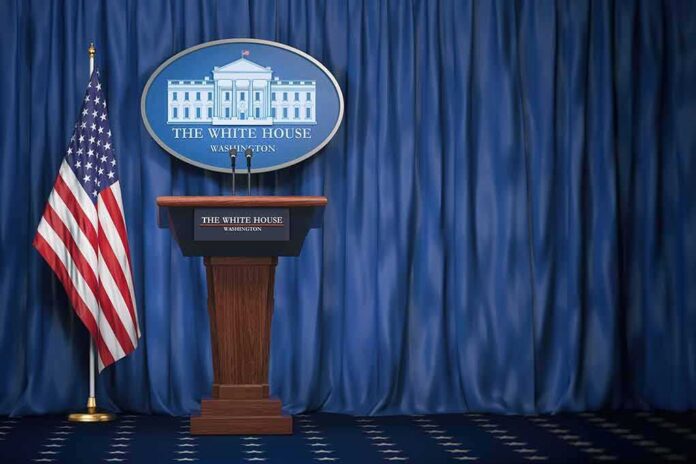
President Trump said he is banning CNN, MS NOW, and Politico from the White House, effective immediately, and the fight over what counts as “news” just got real.
Story Snapshot
- Trump announced a ban on CNN, MS NOW, and Politico from White House access.
- The White House also runs a public “Media Offenders” portal cataloging alleged false stories.
- Press freedom groups argue viewpoint-based bans violate the First Amendment.
- Courts have warned against arbitrary, content-based press credential rules.
What Trump Announced And Why It Matters
President Trump stated that CNN, MS NOW, and Politico are barred from the White House. He said their coverage amounts to “fake news” and that the change starts now. Reports flagged the move as a direct test of press rights and government power over access. This is not just about a room. The White House controls a prized channel to question the president and press officials on policy. Losing that access can reshape what the public hears and when they hear it.
The announcement lands alongside an official “Media Offenders” site that lists outlets and articles the White House says are false or misleading. The page calls itself “A record of the media’s false and misleading stories flagged by The White House”. That is a clear marker of strategy. The administration is not only denying access; it is also building a public case that certain outlets fail basic standards. For supporters, that reads like long overdue accountability. For critics, it looks like government labeling disfavored speech.
The Constitutional Line: Access, Viewpoint, And The Courts
Press freedom groups say the government cannot deny access because of a newsroom’s viewpoint. The Knight First Amendment Institute and the Reporters Committee for Freedom of the Press argue that excluding outlets based on editorial judgments crosses a First Amendment line. A key court precedent warns that arbitrary or content-based criteria for White House press passes are not allowed under the First Amendment. That case is often cited when access turns into leverage. Expect court action if credentials are pulled on those grounds.
Defenders of the White House position often answer that no outlet has a guaranteed seat everywhere, all the time. That is true in a narrow sense. But the standard is not “any reason goes.” The legal test looks for reasonableness and viewpoint neutrality in access rules. If the record shows punishment for critical coverage, the government’s case weakens fast. Conservative common sense says rules should apply evenly, not reward allies and punish foes. If the ban is about chronic factual failures, show the criteria and apply them across the board.
The Stakes For Voters: What You Hear, When You Hear It
White House access shapes which questions get asked in real time. When certain reporters cannot get in the room, the mix of questions changes. That can change what reaches your phone screen first. Scholars call this “access retaliation,” where control over a scarce venue pressures coverage without a formal gag order. You do not need a censor’s stamp to chill tough reporting. You only need to make access feel like a prize for the “right” tone. That is why process and transparency matter as much as the headline ban.
There is a path that honors press freedom and basic fairness. The White House can set clear, written standards tied to conduct and factual accuracy, not viewpoints. It can use documented corrections, retractions, and independent rulings to guide penalties. It can apply those rules to every outlet, right and left, with the same yardstick. That approach fits conservative values: content-neutral rules, due process, and accountability based on facts. Anything less looks like picking winners and losers in the news business.
Sources:
cbsnews.com, rollingstone.com, thewrap.com, dailysignal.com
© integritytimes.com 2026. All rights reserved.