
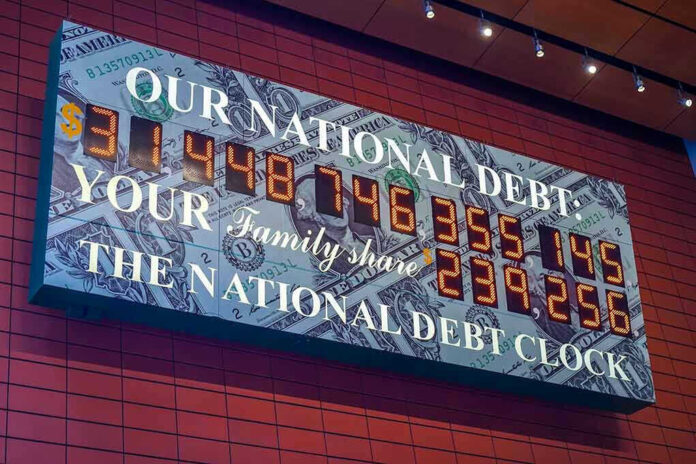
America’s federal deficit exploded to $602 billion in just three months of fiscal year 2026, signaling a fiscal storm that could drown future generations in debt.
Story Snapshot
- U.S. Treasury reports $144.75 billion deficit for December 2025, up 67% from $86.73 billion in December 2024.
- First quarter FY2026 cumulative deficit hits $602.38 billion, accelerating beyond prior years’ pace.
- Tariff revenues surge to $28 billion in December, offsetting 28% drop in corporate taxes amid tax cuts.
- Receipts rise 6.6% to $484.4 billion, but outlays climb faster, widening the gap.
- Calendar year 2025 deficit shrinks to $1.67 trillion, smallest in three years, thanks to record tariff gains.
December 2025 Deficit Breakdown
U.S. Treasury data shows December 2025 federal budget deficit at $144.75 billion. Receipts totaled $484.4 billion, up 6.6% from prior year, fueled by income taxes, social insurance contributions, and customs duties reaching $27.89 billion to $28 billion. Outlays exceeded receipts due to timing shifts and policy effects. This monthly figure beat expectations of $152.5 billion deficit but marked a sharp rise from December 2024’s $86.73 billion.
FY2026 began October 1, 2025. Cumulative deficit for October through December reached $602.38 billion, per Treasury and CBO reports. CBO estimated $601 billion for Q1, closely aligning with final figures. This early-year shortfall outpaces FY2025’s trajectory, where full-year deficit closed at $1.8 trillion.
BREAKING: Total US public debt has hit record $37.9 TRILLION.
This marks a +$400 BILLION jump this month, or +$25 billion per day.
Federal debt has now surged +$1.7 TRILLION since the debt ceiling was raised in July, rising over +$425 billion every month.
At the current… pic.twitter.com/xuc6fOq7P6
— The Kobeissi Letter (@KobeissiLetter) October 18, 2025
Tariffs Drive Revenue Amid Tax Policy Shifts
Trump administration tariffs generated record customs revenue. Calendar year 2025 saw $264 billion from tariffs, up $185 billion year-over-year, shrinking the annual deficit to $1.67 trillion from $2.0 trillion. December customs duties hit $28 billion, down from summer peaks but still elevated. Treasury Secretary Scott Bessent credits these policies for fiscal improvements.
H.R. 1 tax cuts and the “One Big Beautiful Bill Act” slashed corporate tax receipts 28% to $65 billion in December. Income taxes and social insurance rose, but overall revenue growth failed to match outlay increases. Supreme Court reviews tariff legality, creating uncertainty. Common sense aligns with conservative values favoring revenue-neutral tax relief, yet facts show outlays demand scrutiny.
FY2026 Q1 Cumulative Deficit Accelerates
First three months of FY2026 accrued $602.38 billion deficit. Treasury released figures January 13, 2026. Receipts grew, but spending on entitlements and interest outpaced. Compared to FY2025’s $1.8 trillion full year, Q1 pace suggests potential $2.4 trillion annual run-rate without adjustments. Student loan accounting masked FY2025 true deficit above 6% of GDP.
CBO projects FY2026 full-year deficit at $1.713 trillion. New legislation adds $3.4 trillion over 10 years. JPMorgan analysts adjust FY2025 figures above $1.9 trillion. CRFB notes calendar 2025 improvement of $369 billion year-over-year, driven by tariffs despite 5-7% outlay hikes.
Implications for Economy and Policy
Short-term borrowing surges with tax refunds looming. Long-term debt sustainability risks inflation and higher interest costs for taxpayers. Importers face tariff burdens, while corporations benefit from cuts. Political debates intensify on spending restraint versus revenue policies. Conservative principles demand balanced budgets; facts support tariffs’ revenue role but highlight outlay discipline needs.
Bipartisan Policy Center confirms FY2025 revenues up 6% from tariffs, offset by corporate declines. Optimists like Bessent tout wins; skeptics warn of court risks and distortions. Nonpartisan trackers like CBO and CRFB provide baselines urging fiscal responsibility.