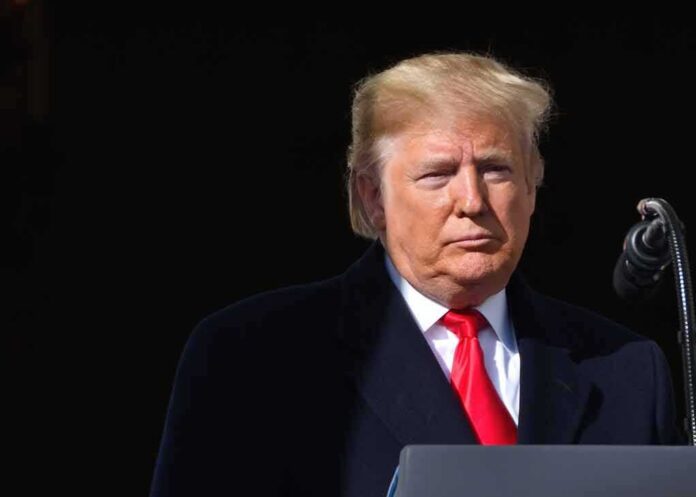
President Trump promised $5,000 to every adult citizen if Republicans control both chambers of Congress after the midterms, and he said the money must be spent in America.
At a Glance
- Trump made the $5,000 “dividend” pledge in Dallas at the first GOP midterm convention.
- The promise is contingent on Republicans winning the House and Senate.
- Coverage across major outlets repeated the same core pledge.
- Reporters estimate a rough $1.35 trillion price tag based on adult population math.
What Trump Promised, Where He Said It, And The Condition
Trump told the Dallas crowd he would issue a $5,000 “dividend” to every adult citizen if Republicans win both the House of Representatives and the United States Senate. He framed it as a corporate-style distribution and said the money must be spent inside the country. Multiple outlets captured the same message in real time, with live updates and post-event stories repeating the core quote and the win-both-chambers trigger. The setting was the party’s first midterm convention, held September 9-10, 2026.
Vice President JD Vance’s follow-up remarks added a wrinkle. He suggested the administration was discussing eligibility limits, such as excluding wealthy adults. That comment signaled the White House might shape the benefit with some form of means test or phase-out, though Trump’s original line used universal language about “every adult citizen”. That gap matters, because eligibility rules change cost, rollout, and public support. It also shapes whether the plan looks like a rebate, a relief check, or a one-time dividend.
How Big Is The Price Tag And What Mechanism Fits The Words
Reuters sized the plan at about $1.35 trillion, using a back-of-the-envelope count of around 270 million adult Americans. That math sets the scale, not the design. A dividend could be delivered in several ways: a direct Treasury payment, a refundable tax credit, a tariff rebate, or a surplus distribution. The campaign-style language leans on a corporate analogy, which helps people grasp the idea quickly but does not specify a funding stream or an agency playbook.
Trump cast the offer as a reward for economic strength, echoing his push for clear, pocketbook wins. He tied the payout to Republican control of Congress to stress mandate and momentum. That framing aligns with conservative themes: make America more productive, then share gains with the people who built them. The domestic-spend condition supports another goal: keep dollars circulating at home to lift stores, factories, and service jobs on Main Street.
Legal And Political Guardrails Around Cash Promises
American law draws a line between public policy promises and private payoffs for votes. The Supreme Court has protected broad campaign promises that would put money in voters’ pockets when tied to future policy, not to a quid pro quo for an individual ballot. That is why sweeping cash pledges appear often in campaigns without triggering automatic legal violations. The campaign context here fits that pattern: a public statement about a national program, contingent on a policy outcome, not a personal inducement.
One practical caveat stands out. Reporters said details on funding and legal authority were not yet public at the time of the speech. That is common at the pledge stage, but Congress would need to pass legislation to authorize and fund checks of this size. If party leaders embrace means-testing, the Department of the Treasury and the Internal Revenue Service (IRS) could use tax data to phase out the benefit at higher incomes. That would lower the cost and target working and middle-income adults.
Economic Stakes, Household Impact, And A Conservative Read
A $5,000 check is a week of breathing room for many families. It covers a car repair, a semester of community college, or a health deductible. For small businesses, domestic-spend dollars could boost local demand before the holidays. The scale also brings risk. A one-time surge in spending can lift growth, but it can also heat prices if supply is tight. That is why the funding source matters. Paying for it with offsetting savings or receipts reduces pressure while keeping the Main Street lift.
President Donald Trump proposed a $5,000 “Trump Dividend” for every American adult if Republicans retain control of Congress in November. The proposal could cost more than $1 trillion and would require congressional approval. Trump made the announcement at the Republican midterm… pic.twitter.com/EUdyIL6kyz
— Houston Chronicle (@HoustonChron) September 10, 2026
Common sense says tie bold promises to clear pay-fors and simple rules. A clean, Congress-passed plan with a defined cap, a clear phase-out for high earners, and a firm spend-by window inside the United States would honor the pledge while guarding against waste. That path reflects core conservative aims: reward work, strengthen families, support small business, and keep the program lean, lawful, and temporary. Trump set the headline. Now the details will decide whether households see the money—and when.
Sources:
youtube.com, cnbc.com, npr.org, reuters.com, nytimes.com, abcnews.com, wtop.com, en.sedaily.com, supreme.justia.com
© integritytimes.com 2026. All rights reserved.