A quiet claim that Washington will strong‑arm states into hiding jury nullification from citizens collapses under scrutiny—and the record shows no names, no bill, and no proof.
Story Snapshot
- Supreme Court affirmed jury trial rights in agency penalty cases, strengthening Seventh Amendment protections [1]
- House bill aims to move agency enforcement cases into federal court for jury trials [1]
- No verified proposal conditions federal funds on states restricting juror knowledge of nullification
- Constitution protects jury trials; disputes persist over the jury’s role and instructions [9][10]
What The Supreme Court Actually Said About Jury Rights
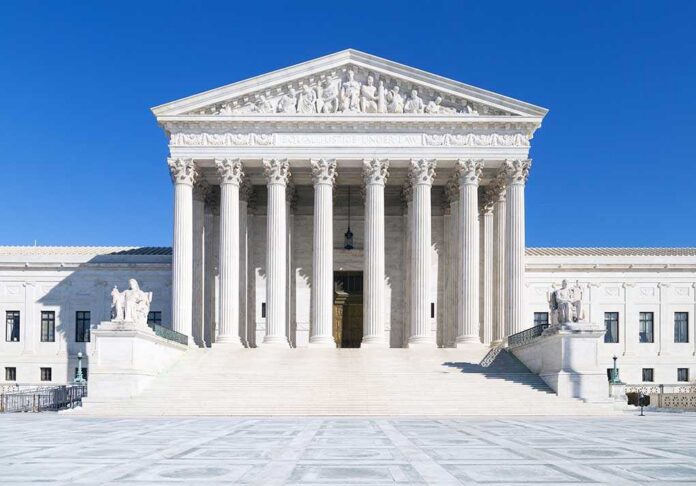
In 2024, the United States Supreme Court decided Securities and Exchange Commission v. Jarkesy, holding that the Securities and Exchange Commission’s in‑house tribunals could not impose civil penalties without affording a jury trial under the Seventh Amendment. Chief Justice John Roberts wrote that a fraud defendant is entitled to trial by a jury of peers before a neutral adjudicator, reinforcing that Americans deserve courtroom accountability when the federal government seeks monetary punishment [1]. The ruling narrowed agency power and reset a key constitutional guardrail.
Conservative readers should view this as a win for due process, not a retreat. The decision curtails bureaucratic overreach that accelerated during prior progressive administrations, where agencies too often acted as investigator, prosecutor, judge, and executioner. By restoring the courtroom and the jury to their rightful place, the Court reaffirmed limits on the administrative state—limits that fit squarely with the principles of separated powers and citizen oversight that conservatives have demanded for years [1].
What Congress Is Proposing—And What It Is Not
Following the Court’s direction, legislation such as the Seventh Amendment Restoration Act, listed as H.R. 432, has been introduced to ensure Americans can remove certain federal agency cases into federal district court for a jury trial. The bill, associated with Representative Harriet Hageman and co‑sponsors, is designed to reaffirm jury access when agencies seek penalties, aligning statutory practice with constitutional standards recognized by the Supreme Court [1]. The proposal’s focus is access to juries, not limiting the information jurors may hear.
Despite online claims, the research turned up no primary‑source bill text, member statements, or hearing records proposing to condition federal funds on states restricting juror information about nullification. There is no named lawmaker, identified bill number, or dated draft that links federal money to state‑level jury instruction limits. A separate congressional discussion on litigation funding transparency does not mention jury nullification or conditioning grants on jury‑instruction policies, further underscoring the evidentiary gap [2].
Constitutional Baseline: Juries, Law, And Instructions
The Constitution guarantees jury trials in criminal prosecutions through Article III and the Sixth Amendment, establishing the jury as a core institution of Anglo‑American justice. The Constitution Annotated explains how those provisions safeguard impartial juries and anchor the legitimacy of verdicts in community judgment [9][10]. Modern courts have generally treated juries as fact‑finders who apply the law as instructed by the judge, even while debates continue in academia and advocacy circles over whether jurors should be told about a power to acquit based on conscience.
No controlling Supreme Court precedent requires judges to instruct jurors on a right to nullify, and the sources reviewed provide no examples of federal grants that successfully forced states to curtail jury‑instruction content. While advocacy groups often argue that juries should be informed of every theoretical option, the record assembled here does not identify any active federal initiative seeking to purchase silence in state courtrooms. Where jury policy has shifted lately, it has concerned access, pay, and selection—not nullification disclosures [8].
Separating Signal From Noise For Conservative Readers
Claims that an unnamed lawmaker aims to keep jurors “in the dark” by tying state funding to gag rules lack documented support in the available materials. Conservatives should demand receipts: a sponsor’s name, bill text, committee markups, or floor remarks. The verified developments trend the other direction—toward reining in the administrative state and reaffirming jury trials when the federal government seeks to punish citizens [1]. That trajectory advances limited government and restores constitutional accountability.
Vigilance remains essential. If any proposal emerges that weaponizes federal dollars to dictate how states instruct juries, it would raise serious federalism and First Amendment concerns. Until then, the prudent course is to champion the clear wins—courtroom juries over agency tribunals—and to press Congress to codify those protections cleanly. Facts, not rumors, should drive our defense of the Constitution, so that real threats are confronted and distractions do not divide or dilute conservative priorities [1][2][9][10].
Sources:
[1] Web – Bill in U.S. House of Representatives would affirm right to jury trial
[2] YouTube – Lawmakers Debate ‘Protecting Third Party Litigation Funding From …
[8] Web – Juror Pay – United States Courts
[9] Web – Amdt6.4.1 Overview of Right to Trial by Jury – Constitution Annotated
[10] Web – ArtIII.S2.C3.1 Jury Trials – Constitution Annotated – Congress.gov