
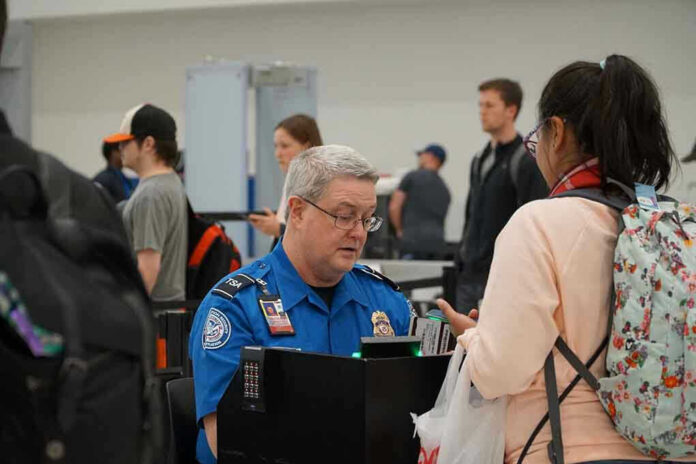
The next time you forget your REAL ID, the TSA won’t just slow you down—they’ll charge you $45 for the privilege of proving you’re you.
Story Snapshot
- TSA begins mandatory “ConfirmID” fees on February 1, 2026 for domestic travelers who show up without a REAL ID or another approved ID.
- The $45 payment covers a 10-day window and requires advance online identity verification through TSA.gov.
- TSA still reserves the right to deny checkpoint access if identity can’t be verified, even after you pay.
- Flexible enforcement continues until May 5, 2027, but the direction is clear: the grace period is shrinking, and friction is rising.
The $45 Wake-Up Call Built Into Your Boarding Pass
TSA’s ConfirmID fee kicks in February 1, 2026, and it changes the psychology of domestic flying. The old pattern was simple: forget the “right” card, expect a lecture and extra screening, still catch your flight. ConfirmID turns that moment into a transaction. Travelers without a REAL ID-compliant license or another accepted form of identification can still fly, but they must complete an online identity verification process and pay $45 for a 10-day validity period.
https://twitter.com/news10nbc/status/2017779962003009892
The detail that should make frequent flyers sit up is the design: the fee isn’t per flight, it’s per 10-day access window. That sounds generous until you picture a household with scattered travel—grandkids’ graduation one weekend, a work trip the next, an emergency flight after that. If you keep rolling without a compliant ID, you risk turning ordinary travel into a recurring “documentation subscription,” except it’s non-refundable and tied to security discretion.
What ConfirmID Requires, and Why It’s Not Just “Pay and Go”
ConfirmID requires action before you hit the airport. Travelers must use TSA.gov to complete identity verification that can involve biometric or biographic checks, then pay the fee and receive a confirmation email. TSA says the online process takes roughly 10 to 15 minutes, while in-person verification at the airport can run 30 minutes or longer. The unspoken risk sits in every time estimate: one delay compounds another when lines and gate times don’t care.
TSA leadership has also emphasized an uncomfortable truth for anyone who believes a receipt equals a guarantee. TSA officers must still verify identity at the checkpoint, and online verification does not promise clearance if the agency can’t complete identity confirmation. That authority matters. A conservative, common-sense reading says government should keep the traveling public safe, but it should also avoid building a system where citizens pay a fee and still face arbitrary outcomes.
REAL ID: A 20-Year Law Finally Acting Like a Deadline
Congress passed the REAL ID Act in 2005 as part of the post-9/11 security reset, aiming to set minimum standards for state-issued driver’s licenses and ID cards. The original schedule targeted implementation years earlier, but political resistance and practical burdens pushed deadlines back again and again. States ultimately moved into compliance, and by 2020 every state had been certified, with territories following later. Then COVID-era extensions ended, and enforcement began May 7, 2025.
The law’s core is paperwork discipline: states must verify identity and lawful status, capture photos, store digital images of source documents, maintain databases, and run fraud-prevention programs. Supporters see a baseline national security upgrade; critics see a federal mandate pushed through state DMVs. Both are partly right. Federal security standards can be legitimate, but the last-mile pain always lands on citizens trying to match old records, names, and life events to today’s required documents.
The Politics of “Flexible Enforcement” and the Reality of the Airport
TSA previously signaled flexibility through May 5, 2027, allowing warnings instead of outright refusal for some travelers during the phased period. ConfirmID fits that same era but changes the terms: flexibility now comes with a bill attached. If government wants broad compliance, a clean and honest approach would be to set a date, communicate it relentlessly, and enforce it evenly. A confusing middle zone—part warning, part fee, part discretion—creates the worst kind of uncertainty.
Airports reward preparation and punish hesitation. The traveler who discovers the problem at the curb, or worse, at the document-check podium, has already lost. Even if ConfirmID can be completed quickly online, real life is messy: weak signal, forgotten passwords, dead phone battery, mismatched names, older adults who don’t scan documents with ease. The process might be “available,” but availability is not the same as accessibility when time and stress spike.
Who Gets Hit Hardest, and Why the Fee Feels Like a Policy Statement
Any fee tied to basic mobility creates a predictable split: organized travelers glide through, everyone else pays in money or time. Low-income travelers, elderly Americans, and people with limited DMV access often struggle most with document gathering and appointment systems. ConfirmID doesn’t fix that; it monetizes the gap. Conservatives tend to support secure identification and rule-following, but common sense also asks whether a new federal fee is the best tool—or just the easiest tool—for a bureaucracy.
The fee also invites a practical question: what problem is it solving that couldn’t be solved through streamlined screening without a charge? TSA will argue modernization and cost recovery. Skeptics will see a revenue mechanism layered onto a mandate that already took two decades to implement. The truth can include both. When agencies start charging citizens to navigate compliance confusion, distrust grows—and distrust is poison for any system that depends on public cooperation.
What Smart Travelers Do Now to Avoid Paying for a Problem Twice
Travelers who want maximum control should treat ConfirmID as an emergency chute, not a routine plan. A REAL ID-compliant license, a valid passport, or other acceptable ID restores predictability. The most practical move is to check expiration dates now, verify your state’s document requirements, and build in time for DMV delays. The worst time to learn your ID is non-compliant is the day you’re flying for a funeral, a medical crisis, or a once-in-a-decade family reunion.
https://twitter.com/BivingsDoris/status/2017765143778668796
ConfirmID’s existence also foreshadows where travel is heading: more pre-verification, more digital receipts, and more “pay to fix it” systems layered over old analog habits. The conservative case for order and security remains strong, but it must come with transparency, simplicity, and equal treatment. If TSA wants Americans to comply willingly, it should make compliance easier than improvisation—without turning a paperwork miss into a toll booth at the gate.
Sources:
Real ID Requirements: TSA to Enforce Fee – ABC News
Real ID – Airlines for America
Real ID Required for U.S. Travelers Beginning May 7, 2025 – Department of Defense Travel