integritytimes.com — A fireball beside Wall Street’s bronze mascot seized global attention, but the unanswered question—what actually ignited that car—matters far more than the viral clip.
Story Snapshot
- A vehicle ignited and exploded near the Charging Bull in Lower Manhattan; thick smoke followed [1][5].
- Reports aligned on the location around Broadway and Stone Street near the landmark [1][2].
- No injuries were reported despite dramatic video and a large response [1][2].
- The cause remains undetermined pending investigation; agencies have not released findings [1][2].
What happened, where it happened, and what we actually know
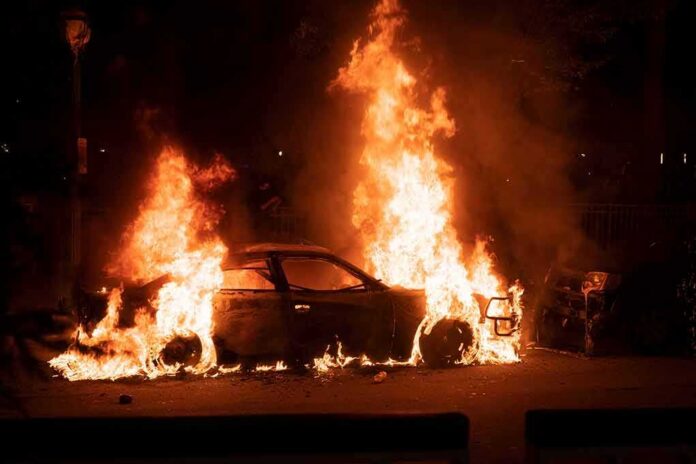
News outlets reported that a car caught fire and exploded Tuesday in Lower Manhattan, sending a plume of smoke over the Charging Bull area, with video circulating widely [1][5]. Coverage placed the scene around Broadway and Stone Street by the famous statue, a location detail that held consistent across independent reports [1][2]. Reporters noted no injuries at the time, a critical point that tempers the mayhem implied by the visuals [1][2]. Video evidence captured flames and a blast, but not a definitive ignition sequence [5].
Initial accounts did not identify the vehicle’s owner or operator, nor whether it was moving, parked, or disabled before the fire [1][2]. Reporters acknowledged that the cause remained under investigation or unknown, which leaves open multiple possibilities from mechanical failure to electrical malfunction to deliberate ignition [1][2]. Without an official incident report from the Fire Department of the City of New York or the New York Police Department, the public record consists of contemporaneous media summaries and on-scene video rather than forensic determinations [1][2][5].
Why “explosion” language spreads faster than facts
Televised and social clips reward spectacle, so “car explodes near Charging Bull” traveled faster than procedural detail. That dynamic fits a well-known news pattern: dramatic visuals dominate the first twenty-four hours, while the cause, ownership, and accountability trail days or weeks behind. Media correctly reported a fire and an apparent blast, but investigators later distinguish fire, deflagration, or true explosion based on debris patterns and ignition sources, not the size of a fireball on video [1][2][5]. Precision matters for insurance, criminal liability, and public safety lessons.
Speculation snuck in around the edges via short-form captions that floated unconfirmed affiliations. Those suggestions lack corroborating documentation and do not meet a common-sense threshold for confidence. Conservative instincts favor restraint: wait for documents, not whispers. A disciplined approach asks for dispatch logs, incident numbers, mechanical histories, and laboratory analysis before inferring motive or institutional fault. Until agencies publish findings, the responsible reading is simple: a car burned and produced a blast near a landmark; the why remains unknown [1][2][5].
How to separate durable facts from rumor in high-heat moments
Start with cross-checked points: the fire and blast occurred; location details match; no injuries were reported; videos corroborate a significant combustion event [1][2][5]. Treat everything else as provisional until backed by official documents. The next meaningful facts will come from fire investigation notes, cause-and-origin determinations, and any mechanical or electrical failure evidence. Nearby building cameras and city traffic feeds can establish a timeline and pre-ignition behavior. Those records, not social captions, will decide whether this was an accident, a defect, or a crime [1][2][5].
Chaos erupted near the Charging Bull statue in Lower Manhattan after a parked car burst into flames and exploded near the busy tourist area
Officials say fire appears to have started in the car before the explosion Investigators are now working to determine exactly what caused it pic.twitter.com/8b2gbs8wsh— NYC News 24 🗞️ (@NYCNews24) May 21, 2026
Public agencies should close the information gap quickly. A brief, factual update—time, location, unit response, preliminary observations—reduces rumor and restores trust. Transparency is not theatrics; it is maintenance of civic order. Citizens deserve clarity without sensationalism, and businesses in the financial district need to know whether this risk was random or preventable. Until that clarity arrives, prudence applies: avoid breathless claims, archive the evidence, and let the investigation tell the story one verified finding at a time [1][2][5].
Sources:
[1] Web – Car catches fire and explodes near New York’s Charging …
[2] Web – Car Explodes in Lower Manhattan, Billowing Smoke Fills …
[5] Web – Video Car catches fire and explodes in Lower Manhattan
© integritytimes.com 2026. All rights reserved.