
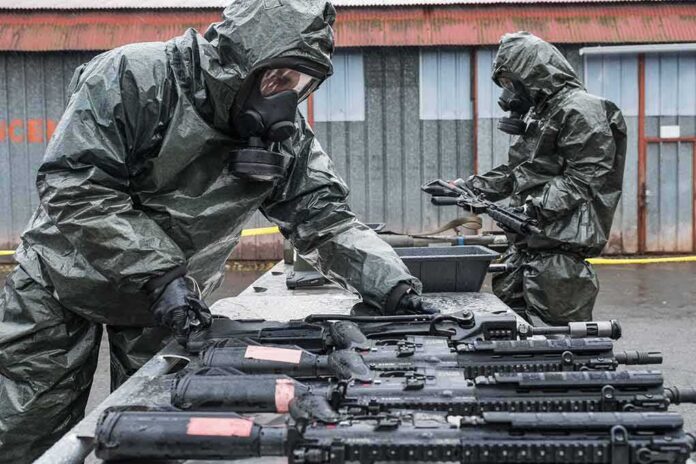
The Army blew up the nation’s entire stockpile of lead azide in Iowa because it had become too unstable to move.
Story Snapshot
- The Army said degraded lead azide risked a sudden, deadly blast if left alone.
- Environmental Protection Agency emergency authority allowed storage and on-site treatment.
- A federal appeals court upheld the Environmental Protection Agency’s emergency permit.
- Public health agencies issued clear protective guidance for nearby communities.
What Happened And Why It Mattered
The U.S. Army carried out a controlled, mitigated detonation at the Iowa Army Ammunition Plant in Middletown. Officials identified the material as degraded lead azide, a sensitive primary explosive that can detonate from shock, friction, or even crystal growth. The Army said the batch had become too unstable to handle or ship, creating a constant risk of an uncontrolled blast. Leaders framed detonation in place as the only way to remove that risk while keeping workers and neighbors safe.
The Environmental Protection Agency issued an emergency hazardous waste permit to store and treat the explosive on-site, citing an “imminent and substantial endangerment” to people and the environment. That authority exists for rare cases where normal waste options are unsafe. The permit outlined conditions, monitoring, and coordination with state and local agencies. A challenge to that permit reached the U.S. Court of Appeals, which left the Environmental Protection Agency’s decision in place during the critical window.
How Officials Reduced Risk Before The Blast
Engineers prepared a mitigation plan to keep debris and dust to a minimum. The plan relied on earthen cover, tamping, remote initiation, and weather windows to limit spread from the pit. State and local health departments pushed clear steps for residents. Guidance focused on staying indoors during the operation, closing windows, avoiding visible dust, and using simple cleaning methods afterward. Agencies aimed for straight talk that people could use in the moment, not jargon or guesswork.
The Army’s public advisory set the schedule, goal, and safety perimeter. It stressed that the detonation removed a standing threat from aging explosives stored in deteriorating containers. Officials said delaying further increased the chance of a spontaneous event with no control measures in place. That logic reflects long-standing emergency practice for explosives that can no longer be safely moved. Once sensitivity climbs past a point, controlled destruction becomes the least bad option.
The Conservative Test: Safety, Authority, Accountability
The facts line up with a common-sense sequence. First, name the danger. Second, cite the legal authority. Third, execute with guardrails. The Army named the hazard and explained why transport would raise the odds of a disaster. The Environmental Protection Agency used an emergency tool designed for rare, time-sensitive threats. Health agencies backed the plan with advice people could act on. That chain of custody for risk and responsibility is the right standard for high-stakes government action.
🚨 UPDATE: We're now 1 HOUR past the lead azide detonation, and ALL EPA live air monitors are still reading 0.0 µg/m³
NO LEAD DETECTED in the air in Iowa.
EPA is giving updates every 5 minutes. https://t.co/RY1uWWUquC pic.twitter.com/DyS6jBZpnz
— Nick Sortor (@nicksortor) November 25, 2026
Critics often ask if officials rushed or ignored options. The better question is whether the record shows real necessity. Here, the Army documented instability, the Environmental Protection Agency issued an emergency permit with conditions, and a federal appeals court declined to stop it. That is a coherent trail of facts and authority. On balance, the assertions by the Army and regulators carry weight because they match the evidence presented in their notices and orders, and they addressed public health in detail.
What Comes Next For Communities
Agencies will debrief the operation and publish data that matter to families and schools. Air and soil checks, weather logs, and on-site sampling help confirm whether controls worked as planned. Officials should keep speaking in plain terms about what they found and what it means. The practical goal is simple: prove the risk is gone, share results fast, and make future stockpiles less likely. Prevention beats emergency detonation every time, but when crisis hits, clarity and control must lead.
Sources:
apnews.com, army.mil, epa.gov, ecf.ca8.uscourts.gov
© integritytimes.com 2026. All rights reserved.