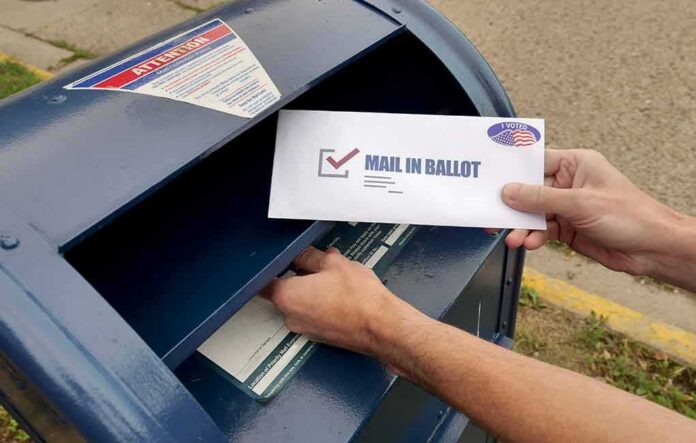
Federal prosecutors say a Utah mail carrier dumped about 300 primary ballots into a church dumpster, and the paper trail backs it up.
Story Snapshot
- A federal grand jury indicted a former Utah mail carrier over hundreds of discarded ballots.
- The Justice Department says the ballots were for Eagle Mountain voters ahead of the June primary.
- Officials said the worker claimed no political motive and pleaded not guilty.
- Rare does not mean impossible; this case exposes a real weak point in mail voting.
What prosecutors say happened and when
The United States Department of Justice announced charges against Damon Matai Seei, 34, a former United States Postal Service letter carrier in Utah. A federal grand jury indicted him for unlawful secretion, destruction, and delay of mail. Prosecutors allege he threw away mail he was supposed to deliver, including about 300 mail-in ballots for Eagle Mountain voters before the June 2026 primary. The indictment states the ballots were among the discarded mail and were clearly part of the election mail stream.
Acting officials detailed the timeline at the announcement. They said Seei separated election mail early in his shift and discarded the ballots in a church parking lot dumpster within a short window that morning. Authorities later recovered the ballots. Seei is no longer employed by the Postal Service. He entered a not guilty plea and was released on his own recognizance while the case proceeds.
The defense claims and what officials concede
Seei told investigators he did not intend to toss ballots and said he was trying to get rid of advertisements to lighten his workload, according to officials who summarized his statements. The United States Attorney for Utah said he indicated there was no political agenda behind his actions. Those points do not change the core charge, but they address motive. A not guilty plea is standard at this stage and signals he will contest the allegation in court.
Prosecutors’ account claims he knew the items were ballots and that they were marked as such. That assertion will likely be central at trial. If jurors find he knowingly discarded ballots, the law treats that as a serious breach of duty. From a conservative view, intent matters for punishment, but the act itself—interfering with other people’s votes—is unacceptable on basic rule-of-law grounds. The proper remedy is prosecution, not excuses.
How one route can shake confidence—and how systems respond
Mail voting runs on trust and routine. One person on one route can still cause harm if they cut corners. That is why mail ballot systems layer safeguards. Ballots are trackable pieces of election mail. The United States Postal Inspection Service investigates tampering. County clerks can reissue ballots if needed, and voters can check status portals in many states. These checks do not make misconduct impossible, but they help catch it quickly and limit damage.
Mail voting depends on a simple promise: the ballot sent to a voter will actually reach the voter.
Federal prosecutors say former Utah postal worker Damon Matai Seei threw away mail assigned for delivery on June 3, including about 300 ballots for Eagle Mountain residents before… pic.twitter.com/fMPD58nZJF
— Dan Holbrook (@DanHolbrook) September 23, 2026
Large-scale research shows mail-ballot fraud and interference are rare compared with total volume. Studies from the Massachusetts Institute of Technology Election Data and Science Lab and reviews by the Brookings Institution find very low rates of proven cases across many election cycles. Critics cite vulnerabilities, and they exist, but the data show they seldom turn into organized abuse. The right lesson is not denial or panic. It is steady tightening of weak links and real penalties when people break the rules.
Policy stakes: prevent the easy failure first
Election integrity improves when we target human failure points. Common-sense steps fit conservative principles: assign tighter supervision for temporary or high-volume routes during election windows, require signature scans on pickup and drop at key points, and flag spikes in route-level election mail for spot checks. None of these steps limit lawful voting. All of them raise the chance that a clerk or inspector spots a missing bundle the same day. Accountability plus transparency beats theater.
Bottom line
The indictment tells a simple story: a trusted carrier allegedly tossed a few hundred ballots and got caught. The courts will sort intent and punishment. Voters deserve both truths at once. First, this behavior is a bright red line and must be charged. Second, the broad mail system still works at scale, and data show abuse remains rare. We harden the system by closing easy gaps, not by scaring people away from their ballot box—at home or at the polls.
Sources:
justice.gov, nbcnews.com, local10.com, patrickneilbradley.com
© integritytimes.com 2026. All rights reserved.