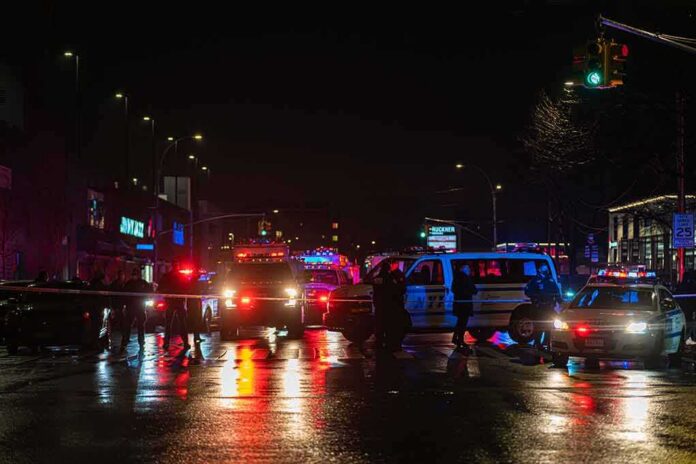
Austin neighbors were told to shelter in place as reports of multiple street shootings mounted, reviving hard questions about public safety, media rushes to judgment, and how fast officials can credibly brief a city under fire.
Story Snapshot
- Police treated Austin’s latest multi-location gunfire reports as an urgent, mobile threat; prior Austin cases show why.
- Confusion over “random” versus connected shootings underscores how early labels often change as facts firm up.
- Past Texas incidents demonstrate rapid police response and evolving suspect narratives, for better and worse.
- Without an official May 17 incident log, key details—suspect count, motive, links—remain unverified.
Police Urgency In Multi-Site Gunfire Events
Austin residents received shelter-in-place guidance after reports of multiple shootings across the city, and officers reportedly treated the developing situation as an active, mobile threat. Prior Austin experience offers context: during the March 1, 2026 nightlife shootings, city police and emergency medics arrived within 57 seconds of the first calls, reflecting a posture that prioritizes swift interdiction when violence appears to move between locations [1]. Rapid response can save lives, but it also means early public statements may be provisional.
Officials often escalate resources when attackers appear to be using vehicles or moving between scenes. In March 2026, investigators said the perpetrator fired from a vehicle and later used a rifle along West Sixth Street before being stopped by police gunfire, a sequence that validated immediate, citywide risk assessment and dynamic tactics [1]. When radio traffic stacks up from several scenes at once, agencies warn civilians broadly, then refine guidance as dispatch times, shell casings, and witness accounts get sorted.
Why “Random” Labels Are Risky In Real Time
Early characterizations can mislead if they outrun evidence. In a separate North Texas case, the Carrollton police chief told reporters a shooting at a shopping center was “not a random act of gunfire,” narrowing the threat description even as the investigation unfolded [2]. That contrast shows how “random” is an evidentiary conclusion, not a default. In Austin’s high-traffic corridors, overlapping 911 calls can paint either a spree or a cluster of unrelated crimes until forensics and interviews connect the dots.
Investigators frequently caution that motives and suspect counts take time to corroborate. In another widely covered Central Texas spree, local coverage emphasized the “early hours” of the probe with hundreds of witnesses, stressing that motive declarations would be premature until statements, scene diagrams, and ballistic links matured into a cohesive timeline [3]. For citizens, the takeaway is practical: heed immediate safety directives, but expect details—randomness, conspiracy, number of shooters—to evolve as police validate each specific claim.
Facts Known, Facts Missing, And What To Watch
Public safety depends on separating verified facts from rumor cascades. The strongest on-record details in the available record describe prior Austin and Texas cases, not the specific May 17 South Austin sequence—meaning today’s core claims about nine scenes, four victims, and multiple suspects remain unconfirmed in the provided materials [1][2][3]. Without an Austin Police Department alert text, dispatch chronology, or arrest affidavits, certainty about links between scenes or whether shooters coordinated is not yet supported.
Austin Shooting Spree: 4 Shot in 9 Random Attacks, Shelter-in-Place Alert Issued https://t.co/xunngb8cKQ
— DLW 🔥#MAGA (@Dlw20161950) May 17, 2026
Conservative readers should demand transparency and competence from local leadership while backing law enforcement’s need for time to verify. Responsible next steps include releasing a scene-by-scene incident map, redacted 911 timestamps, and preliminary ballistic comparisons. Those records would clarify whether Austin faced a single mobile attacker, multiple actors, or a conflation of separate crimes. Until then, treat viral posts and speculative motive claims cautiously, and measure officials by how promptly they produce verifiable evidence.
Sources:
[1] Web – 2026 Austin bar shooting – Wikipedia
[2] YouTube – Central Texas shooting spree leaves six dead, including suspect’s …
[3] YouTube – Central Texas shooting spree subject set to appear in …