A suicidal man from Indiana forced Secret Service agents into a life-or-death decision just steps from the White House, turning a quiet Saturday night into an armed confrontation that underscores how mental health crises increasingly collide with America’s most fortified perimeters.
Story Snapshot
- Secret Service shot an armed man near the White House after midnight Sunday following alerts from Indiana police about a potentially suicidal individual heading to Washington
- Agents located the man’s vehicle near 17th and F Streets NW, confronted him on foot, and fired when he brandished a handgun
- The suspect was hospitalized with unknown condition; no Secret Service agents injured, and President Trump remained safe at Mar-a-Lago
- D.C. Metropolitan Police now lead the use-of-force investigation, while the incident mirrors a 2016 shooting involving another mentally distressed armed individual
When Cross-State Intelligence Saves Lives
Indiana police triggered a chain reaction Saturday that likely prevented a worse outcome. They identified a suicidal individual possibly traveling to the nation’s capital and alerted federal authorities. This real-time intelligence sharing enabled Secret Service agents to locate the man’s parked car near the Eisenhower Executive Office Building, a block west of the White House, before he could reach the most sensitive security zones. The preemptive coordination between local and federal law enforcement demonstrates how mental health emergencies now require multi-jurisdictional tracking to protect both the distressed individual and high-value targets.
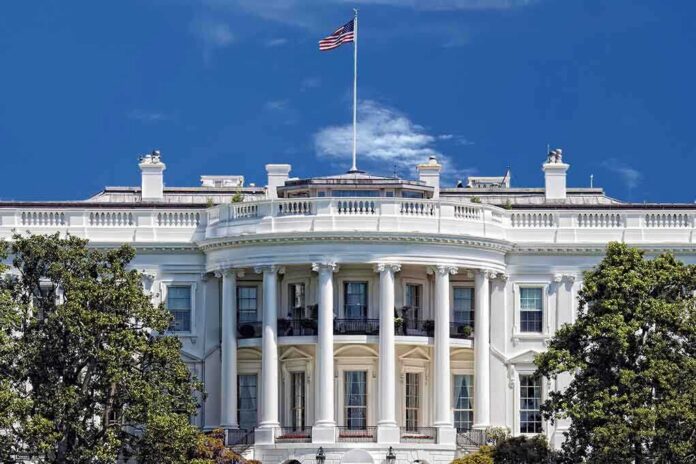
The confrontation unfolded just after midnight near 17th and F Streets NW, in a high-security zone where the West Wing operations anchor the executive branch. Agents spotted a man matching the description on foot and approached. The Secret Service statement was direct: the individual brandished a firearm, an armed confrontation ensued, and shots were fired. Within minutes, the man was rushed to a local hospital, his condition still unknown at the time of reporting. No agents sustained injuries, and the incident prompted no White House evacuation or lockdown, a striking contrast to how similar scenarios might have escalated.
Echoes of Past White House Perimeter Threats
This confrontation follows a troubling pattern. In May 2016, Jesse Olivieri, a 30-year-old Pennsylvania man with a mental health history, approached a White House checkpoint at 17th and E Street with a firearm. He ignored commands, was shot in the stomach by Secret Service agents, and survived. The White House locked down for 45 minutes while President Obama was absent and Vice President Biden was secured. Investigators found no terrorism link, only another person in crisis who chose the White House as the backdrop for his breakdown. The 2016 incident resulted in procedural reviews, yet nine years later, the same vulnerability persists: desperate individuals with firearms drawn to the symbolic heart of American power.
The absence of President Trump from the White House during Sunday’s shooting minimized political disruption. He was scheduled to return from Mar-a-Lago at 5 p.m., hours after the incident concluded. This timing reduced the immediate security threat level and allowed agents to focus on neutralizing the armed individual without the added pressure of protecting a sitting president on-site. The lack of broader lockdown measures suggests the Secret Service assessed the threat as isolated, not part of a coordinated attack or broader conspiracy, a critical distinction in an era where every gunshot near the White House invites speculation.
When Mental Health Becomes a Security Crisis
The suspect’s suicidal intent, flagged by Indiana authorities, transforms this from a simple security breach into a public health tragedy playing out in a federal security zone. Suicidal individuals often seek high-profile locations for final acts, seeking attention or forcing law enforcement into lethal confrontations they cannot initiate themselves. The Secret Service trains for armed threats, but protocols designed for adversaries don’t always align with de-escalation tactics suited for mental health crises. This incident will likely prompt renewed calls for specialized training in handling suicidal armed subjects, balancing the imperative to protect federal assets with the desire to preserve life when possible.
D.C. Metropolitan Police now lead the use-of-force investigation, standard procedure when federal agents discharge weapons in the District. This deference to local oversight ensures accountability and transparency, though the outcome seems foregone: an armed individual brandishing a weapon at federal agents near the White House leaves little room for questioning the justification of returned fire. The investigation will scrutinize the sequence of events, whether commands were issued, and if alternatives existed, but the facts as reported align with established protocols for protecting the White House perimeter.
Broader Implications for Federal Security Protocols
This confrontation underscores gaps in addressing mental health threats before they reach critical federal sites. The Indiana-to-D.C. journey provided a window for intervention that ultimately ended in gunfire. Could mental health professionals have intercepted the individual en route? Should federal agencies develop rapid-response teams equipped to manage suicidal threats distinct from terrorism or assassination plots? The answers will shape future protocols, but for now, the Secret Service relies on intelligence sharing, quick identification, and armed response when subjects escalate. The lack of injuries to agents or bystanders marks this as a successful tactical outcome, even as the hospitalized suspect’s fate remains uncertain.
No evidence suggests terrorism, political motive, or organized threats. The uniformity across reporting sources, all citing the Secret Service’s official statement, reinforces the incident’s classification as a mental health crisis intersecting with federal security. The investigation will clarify remaining uncertainties such as the suspect’s identity, his current medical condition, and whether the handgun was loaded or operable. For now, the takeaway is clear: America’s most protected address remains a magnet for troubled individuals, and the men and women guarding it face split-second decisions where hesitation could mean catastrophe.
Sources:
Secret Service shoots man in overnight armed confrontation near White House – Fox29
Secret Service shoot armed man near White House – CBS News
2016 White House shooting – Wikipedia