
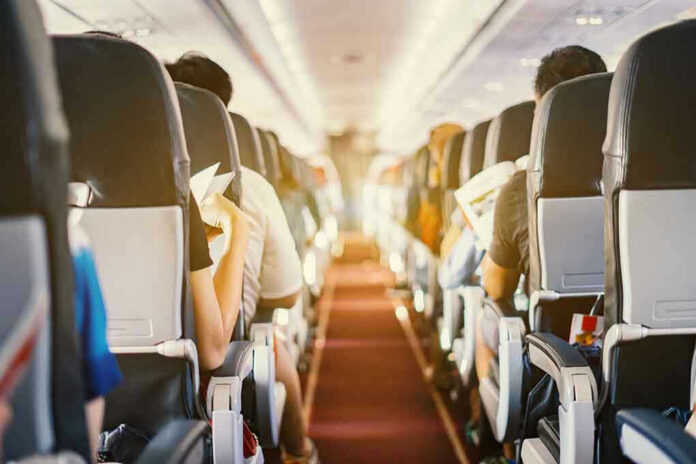
United Airlines just became the first major U.S. carrier to permanently ban passengers who refuse to wear headphones while playing audio or video on flights, turning what was once a polite suggestion into a legally enforceable rule that could leave you stranded at the gate.
Story Snapshot
- United Airlines updated its contract of carriage on February 27, 2026, making headphone use mandatory for all audio and video playback during flights
- Passengers who refuse compliance face removal from the aircraft and potential permanent bans from the airline
- The policy positions headphone use as a safety measure under passenger wellbeing, not just etiquette
- Free basic earbuds are available from flight attendants, subject to availability
- United stands alone among major carriers in codifying this rule with enforcement consequences
When Common Courtesy Becomes Airline Law
United Airlines slipped a deceptively simple change into its contract of carriage late last month. Tucked into the “refusal of transport” section, the new language requires passengers to use headphones when listening to any audio or video content. What distinguishes this from the vague requests other airlines make is the consequence: violators can be removed from flights and banned permanently. The airline frames the requirement under safety and passenger wellbeing, making it as binding as rules against smoking or wearing inappropriate clothing.
Delta and Southwest encourage headphone use through informal policies, but neither airline ties noncompliance to removal or bans in their legally binding passenger agreements. United’s approach transforms a social expectation into contractual obligation. Flight attendants, who already function as safety officers backed by FAA authority, now have explicit grounds to intervene when passengers blast Candy Crush soundtracks or stream videos at full volume. The airline offers free earbuds to passengers who lack their own, though availability depends on onboard inventory.
The Noise That Broke the Camel’s Back
Airplane etiquette battles stretch back to the early days of cell phone use, but personal device proliferation turned cabin noise into a persistent flashpoint. Parents allowing children to play games without headphones have become the emblematic offenders, according to etiquette expert and former flight attendant Jacqueline Whitmore. She calls the policy overdue, noting that noise complaints have plagued carriers for years. The timing aligns with broader industry crackdowns: Spirit Airlines recently banned inadequate clothing, France introduced fines for passengers who block aisles, and airlines worldwide report a 400 percent spike in flight violence prompting U.S. Department of Transportation civility campaigns.
The policy arrives as airlines tighten rules across multiple fronts. Some carriers ban certain smart glasses, others prohibit Bluetooth earbuds in checked luggage due to lithium battery risks, and Southwest eliminated free checked bags. United’s headphone mandate fits this pattern of formalizing standards that were previously left to crew discretion. What raises eyebrows is enforcement consistency. United faced criticism when a passenger flew pantless without consequences, yet now threatens permanent bans for audio violations. This gap between selective enforcement and rigid rules suggests airlines are still calibrating where etiquette ends and safety begins.
The Enforcement Question and What Comes Next
As of early March 2026, no ejections or bans have been publicly reported under the new policy. Whitmore expects United to issue warnings before escalating to removals, giving passengers a chance to comply or accept offered earbuds. Flight attendants hold considerable authority in these situations, with FAA backing for safety-related directives. The contract language allows United to seek reimbursement for any “loss, damage or expense” caused by noncompliance, though how the airline would calculate such costs remains unclear. The provision suggests United anticipates not just ejections but potential legal disputes over enforcement.
The broader implications extend beyond United’s cabins. Other major carriers may follow suit, especially if the policy reduces passenger complaints without significant backlash. Industry watchers note that codifying etiquette as enforceable safety measures could standardize expectations across airlines, much like smoking bans did decades ago. Whitmore already advocates for the next target: banning pajamas on flights. The DOT’s push for onboard civility amid violence spikes provides regulatory cover for these moves. Passengers frustrated by shrinking perks and expanding restrictions find themselves navigating an environment where common courtesy failures now carry the same weight as security violations.
Passengers refusing to wear headphones on flights could be kicked off aircraft: 'It's about time'
Policy change at United Airlines gives flight crews clearer authority to remove passengers for non-compliancehttps://t.co/hxKzbdrnrO
— 🇺🇲 Publick Occurrences both Foreign and Domestic (@BenHarris1690) March 5, 2026
United’s gamble is that most passengers will appreciate quieter flights enough to accept another layer of regulation. The policy appeals to travelers exhausted by inconsiderate seatmates, while critics see mission creep in airline authority. What’s undeniable is that personal freedom in the skies continues shrinking, with carriers wielding contracts as blunt instruments to enforce behavior once governed by social norms. Whether this marks a necessary correction after years of deteriorating onboard conduct or an overreach into minor annoyances depends largely on whether you’ve ever sat next to someone streaming TikTok videos at maximum volume for three hours straight.
Sources:
Major US Airline Will Start Removing Passengers Who Don’t Wear Headphones
Passengers refusing to wear headphones on flights could be kicked off aircraft: ‘It’s about time’