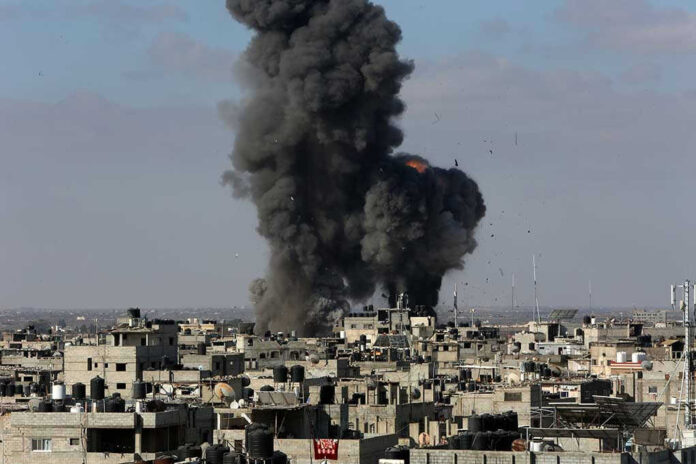
American jets just turned a dusty stretch of Syrian desert into a message board, and the message was brutally simple: if you kill our people, we will hunt you down anywhere on earth.
Story Snapshot
- Operation Hawkeye Strike ties national power to the deaths of two Iowa Guardsmen and a U.S. interpreter near Palmyra.
- U.S. and partner forces are hitting ISIS targets “throughout Syria,” not just one village or one valley.
- A post-Assad Syrian government has joined the anti-ISIS coalition, reshaping who stands where on the battlefield.
- CENTCOM’s language is as important as its missiles: deterrence through certainty, not ambiguity.
Retaliation With A Name, A Memory, And A Message
American aircrews did not launch the latest wave of strikes under some bureaucratic label buried in a Pentagon spreadsheet. They flew under Operation Hawkeye Strike, a campaign named for the Hawkeye State after two Iowa National Guard soldiers and a U.S. interpreter were gunned down near Palmyra on December 13 by an ISIS-affiliated attacker. That naming choice matters. It tells every would-be jihadi this is not abstract “force posture”; it is personal accountability attached to American blood.
CENTCOM’s public line stripped away the usual diplomatic varnish: if you harm U.S. warfighters, American forces will “find you and kill you anywhere in the world.” That is not the cautious prose of interagency consensus; it is a promise that aligns with a core conservative instinct—peace through strength backed by consequences, not press releases. When a lone gunman thinks he can ambush a U.S. convoy and melt back into the landscape, this kind of response redraws the mental map.
From One Ambush To Seventy Targets And Beyond
The chain of events moved fast by Washington standards. Six days after the Palmyra ambush, U.S. and Jordanian aircraft opened Hawkeye Strike with a large-scale package against roughly 70 ISIS targets across central Syria, focusing on weapons depots and infrastructure that keep an insurgency alive. In the ten days that followed, CENTCOM logged 11 missions that killed at least seven ISIS members, captured others, and destroyed four weapons caches. Those numbers are small on a global scale but huge inside a clandestine network.
The latest wave, launched around 12:30 p.m. Eastern on a Saturday, expanded the campaign from “central Syria” to ISIS sites “throughout Syria,” again with unnamed partner forces alongside U.S. assets. That geographic shift matters. ISIS has survived by slipping between seams—between Kurdish areas and regime zones, between deserts and river towns. When American planners say “throughout,” they signal fewer safe seams and less respect for imaginary red lines drawn by terrorists who control no recognized state.
A New Syrian Government Changes The Ground Game
The backdrop to these strikes would have been unthinkable a few years ago. Bashar al-Assad is gone, replaced in late 2024 by a new Syrian leadership that has not only sought international reintegration but actually joined the Global Coalition to Defeat ISIS. U.S. envoy Tom Barrack now meets openly in Damascus with President Ahmed al-Sharaa and senior ministers to talk about Aleppo’s recovery and Syria’s political transition, while reaffirming long-term cooperation against ISIS. The regime that once enabled jihadist gamesmanship now frames ISIS as a common enemy to be crushed, not leveraged.
That political shift does not erase the importance of the Syrian Democratic Forces, whose Kurdish- and Arab-led units bled for years as America’s main ground partner. It does, however, create a more complicated map. Damascus wants sovereignty and legitimacy; the SDF wants security and recognition; Washington wants ISIS dead and regional stability at a tolerable cost. When CENTCOM says Hawkeye Strike is conducted with “partner forces,” that phrase now likely covers both SDF elements and units loyal to the new Syrian government. Shared enemies make uneasy allies, but they do not change what a JDAM does to an ammunition dump.
Deterrence, Justice, And The Conservative Instinct For Clarity
Supporters of a harder line against jihadist groups will see Hawkeye Strike as overdue clarity. For years, critics on the right argued that treating ISIS purely as a policing problem, indictments, designations, and carefully calibrated micro-strikes, invited more attacks on Americans. CENTCOM’s current rhetoric and tempo push decisively in the opposite direction: hit back fast, hit back hard, and tie every strike to the specific crime that triggered it. That approach fits common-sense justice: a man who ambushes an American patrol should expect more than a hashtag.
At the same time, experience since 2014 shows no air campaign, however punishing, can erase ISIS’s ideology by itself. The group morphed from a territorial caliphate into an underground insurgency that plants IEDs, organizes ambushes, and dreams of prison breaks. The arrest of the ISIS military leader for the Levant announced by Syrian officials the day before the latest strikes suggests pressure is now applied both from the sky and on the ground. That is how serious counterterrorism looks: relentless, layered, and unapologetically focused on American lives first.
Sources:
ABC News – US carries out additional ‘large-scale’ strikes on ISIS targets in Syria
Military Times – US launches retaliatory strikes against ISIS in Syria
KOMO News – US launches attack against ISIS in Syria
Wikipedia – Timeline of the Islamic State (2025)