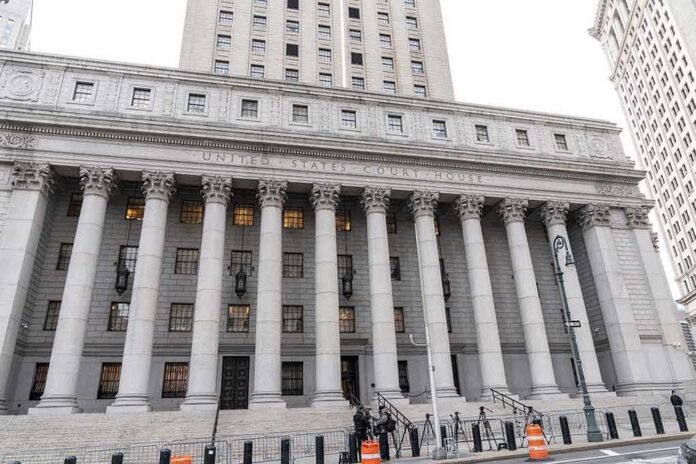
integritytimes.com — A single word from a police chief — “belligerent” — is quietly deciding the narrative of a courthouse gunfight you were never supposed to see on security tape.
Story Snapshot
- Two Fox Rothschild lawyers representing a small-town police department were gunned down steps from a Wake County courthouse after a civil hearing. [2][5]
- Police say 57‑year‑old Gwendolyn White “became belligerent in court,” left, fetched her vehicle, returned, and opened fire. [1][2][4]
- The simmering dispute: a years‑long fight over access to police body‑camera footage from Rolesville, North Carolina. [2][5]
- Nearly every detail you have heard so far comes from law enforcement press briefings, not courtroom transcripts or released video. [1][2][5]
Courthouse Steps Turn Into A Crime Scene
On a Friday morning in downtown Raleigh, routine civil arguments on the tenth floor of the old Wake County courthouse emptied onto Martin Street; minutes later, two attorneys lay shot on the pavement. Raleigh police say both lawyers had just left a civil hearing where they represented the Town of Rolesville and its police department, facing off against 57‑year‑old Raleigh resident Gwendolyn White. [2][5] First responders described both victims with multiple gunshot wounds, one requiring emergency surgery.
Police quickly moved from chaos to narrative. Raleigh Police Chief Rico Boyce told reporters that White, the victims, and court staff had all been in the same courtroom that morning for the same case. [2][4] He said the suspect “became belligerent in court,” then, after the case ended, left the building, got to her vehicle, returned, approached the two attorneys as they exited, and shot them. [1][2] Officers captured her soon after, and she was taken into custody and later charged with attempted murder. [1][2]
The Hidden Battle Over Police Body-Camera Footage
Beneath the flashing lights and crime-scene tape sat a different story: a four‑year legal war over police body‑camera recordings. Local reporting ties the shooting to a 2021 incident in Rolesville and a long-running dispute in which White sought access to officer‑worn body‑camera video from the town’s police department. [2][5] The News & Observer summarized it bluntly: the woman officials say pulled the trigger was fighting to obtain those police videos when the courthouse encounter occurred. [5]
The two wounded attorneys, later identified as Mary Harris and Jeffrey Whitley of the national firm Fox Rothschild, had represented Rolesville for decades according to a town statement quoted in broadcast coverage. [3] They were not random targets; they were the institutional face of a police department resisting or tightly controlling disclosure of its own recordings. [5] When conflict over government transparency collides with individual grievance, the stakes move from abstract civil liberties to something far more combustible.
Who Controls The Story When Only One Side Has The Microphone?
Every early account the public received leaned heavily on police framing. National outlets and local television repeated Chief Boyce’s description almost verbatim, anchoring the narrative on two claims: belligerent behavior in court and a deliberate departure‑return‑attack sequence. [1][2][4] Yet the materials now visible to the public do not include a hearing transcript, courtroom audio, clerk’s minutes, or any written finding from a judge describing White’s conduct or confirming the precise timeline. [1][2][5]
From a rule‑of‑law perspective, that asymmetry matters. When law enforcement both controls the security perimeter and dominates the microphone, there is a natural incentive to emphasize the suspect’s volatility and downplay institutional failures. A label like “belligerent” sounds specific, but without record evidence it functions as a character judgment, not a legal finding. For a conservative reader who values due process, that should raise a red flag: the state must prove its case with evidence, not adjectives.
Courthouse Security, Soft Targets, And Missed Interventions
Courthouses are supposed to be where disputes cool down, not where they ignite. Yet security experts have warned for years that American courts are “soft targets”: open doors, emotional stakes, metal detectors that mostly screen for today’s visitor, not for who storms back tomorrow. White allegedly left the building, accessed a firearm from her vehicle, and then returned close enough to shoot the attorneys outside the courthouse entrance. [1][2]
Gwendolyn White faces attempted murder charges for shooting attorneys Mary Harris and Jeffrey Whitley outside the Wake County courthouse following a civil hearing.
Read more on our Website. #Raleigh #WakeCounty #CourthouseShooting pic.twitter.com/yXBQJppMkG
— The New York Editorial (@nyeditorialus) May 23, 2026
If that sequence holds up under released video and forensic review, it points to a hard question: once someone “became belligerent” in a high‑conflict case, why was there no elevated security posture when everyone walked out? Either the belligerence was not serious enough to trigger action, or staff dismissed it until bullets flew. Both possibilities indict the system more than any talking point about one woman’s temper. Personal responsibility and institutional responsibility are not rivals; a sane justice system insists on both.
What We Still Do Not Know — And Why It Matters
Major gaps remain. The public has not yet seen the criminal probable‑cause affidavit, the full civil‑case docket, or courthouse security footage that could confirm or complicate the police narrative. [1][2][5] No neutral eyewitnesses, such as court clerks or the presiding judge, have been put on record describing White’s actual words or behavior before the hearing ended. [1][2] The exact legal nature of the body‑camera dispute, and what those videos might show, still sits mostly in the dark. [5]
None of that uncertainty excuses violence; on the available facts, prosecutors appear justified in pursuing serious charges when two unarmed attorneys are shot outside a courthouse. [1][2] But a healthy skepticism toward any government institution — including police and courts — demands that we push for full evidence, not just press conferences. If the state can define a person as “belligerent,” deny the public the underlying records, and then use that framing forever, we have drifted away from transparency and toward narrative management.
Sources:
[1] Web – 2 attorneys shot outside courthouse after civil court case ends
[2] Web – Chaos at the courthouse: Woman shot 2 attorneys, police say – WRAL
[3] YouTube – Fox Rothschild lawyers shot in downtown Raleigh
[4] YouTube – Court case, shooting in street in downtown Raleigh
[5] Web – Wake courthouse shooting tied to 2021 Rolesville dispute
© integritytimes.com 2026. All rights reserved.