One bullet from a Minneapolis officer’s gun did more than kill Renée Nicole Good; it blew open a national fight over who really controls armed federal power in American neighborhoods.
Story Snapshot
- A fatal ICE shooting in Minneapolis turned a local confrontation into a nationwide anti-ICE protest wave.
- Federal claims of “absolute immunity” for the shooter collide with state prosecutors insisting on their authority.
- Thousands of federal agents are being poured into Minnesota as officials argue over access to basic evidence.
- Americans are watching a real-time stress test of federalism, public safety, and accountability.
A single traffic encounter becomes a national political fault line
On January 7, 2026, an ICE officer shot and killed 37-year-old Renée Nicole Good during a vehicle confrontation in a Minneapolis neighborhood, and within days thousands of people filled city streets demanding answers. Federal officials at the Department of Homeland Security quickly alleged that Good tried to run over officers with her car, framing the killing as self-defense, while local authorities stressed that the facts remain incomplete and video evidence is still under review. That gap between federal certainty and state caution is exactly where public trust tends to die.
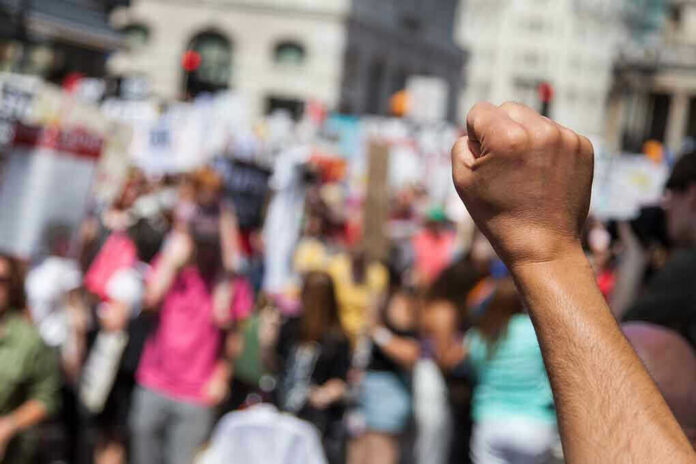
Protests did not wait for the paperwork to catch up. Vigils began the next day, then rolled into marches that drew thousands to the shooting site by Saturday, the fourth straight day of demonstrations. Crowds in Minneapolis chanted against ICE and the broader immigration crackdown, while smaller solidarity protests took shape in New York City and Washington, D.C., turning a single shooting into a referendum on the Trump administration’s interior enforcement surge. For a country that watched the George Floyd protests unfold from the same city, the images feel grimly familiar.
Federal claims of immunity collide with state demands for accountability
Power struggles surfaced almost faster than the protest chants. Vice President J.D. Vance publicly declared that the ICE officer was protected by “absolute immunity,” signaling to many Americans that Washington had already decided the outcome before any investigation could run its course. Hennepin County Attorney Mary Moriarty immediately pushed back, insisting her office has jurisdiction and that no federal officer enjoys a blanket shield from state criminal law merely by flashing a badge. Her response reflects a basic conservative instinct: no one in government should be above the law they enforce.
Behind the podium battles sits a quieter but more consequential fight over evidence. The FBI is leading the primary criminal investigation and holds key materials, including Good’s vehicle and forensic data, while state investigators report “really none” access to federal officers and some physical evidence. Moriarty and Minnesota Attorney General Keith Ellison have resorted to asking the public to upload cellphone videos and information to a county website, effectively crowdsourcing what they cannot compel from Washington. When a county attorney relies on citizens with smartphones to offset federal stonewalling, something in the federalism bargain is badly off.
An ICE surge deepens fear, division, and legal uncertainty
The shooting did not occur in a vacuum; it landed on a city already saturated with federal agents. Since early December, the Trump administration has surged ICE and other federal law enforcement into Minneapolis, citing migrant-related crime and border concerns, and now officials acknowledge that “thousands” of federal officers have been deployed, with hundreds more on the way. Supporters call this a necessary restoration of law and order, but for residents, especially in immigrant communities, it feels like occupation more than protection.
Republican lawmakers generally echo DHS’s self-defense account and argue that officers have the right to use lethal force when they feel threatened, which aligns with a traditional law-and-order view. Yet that principle rests on a crucial condition: a transparent, independent review to confirm the threat was real, not invented after the fact. Democrats in Congress, meanwhile, warn that calling Good’s alleged actions “domestic terrorism” and locking investigative control inside federal agencies risks turning legitimate enforcement into a shielded political project rather than a neutral application of law. Without clarity on the standard for lethal force, both officers and civilians operate in a legal fog.
Protests test restraint, while government tests the limits of trust
Street-level reality has been more disciplined than many feared. Protests in Minneapolis have remained overwhelmingly peaceful despite some arrests, with the city’s mayor publicly praising demonstrators for their restraint and urging continued nonviolence. Governor Tim Walz has issued a warning order to prepare the Minnesota National Guard, signaling concern about possible escalation while stopping short of immediate deployment. That calibrated response reflects a lesson writ in 2020: visible overreaction can inflame a situation faster than any protest organizer.
Washington’s posture moves in the opposite direction. The administration has tightened rules on congressional visits to immigration detention facilities, and three House Democrats were denied entry to a Minneapolis site soon after the shooting, raising alarms about obstructed oversight. Some administration and ICE officials reportedly worry that controlling access and leaning on immunity rhetoric may win a short-term confrontation but inflict long-term damage on public trust in federal enforcement. From a common-sense, conservative perspective, that concern is justified: a government that demands deference while withholding transparency eventually invites backlash from both left and right.
Sources:
Republicans, Democrats dig in after Minneapolis ICE shooting as protests spread (Politico)