
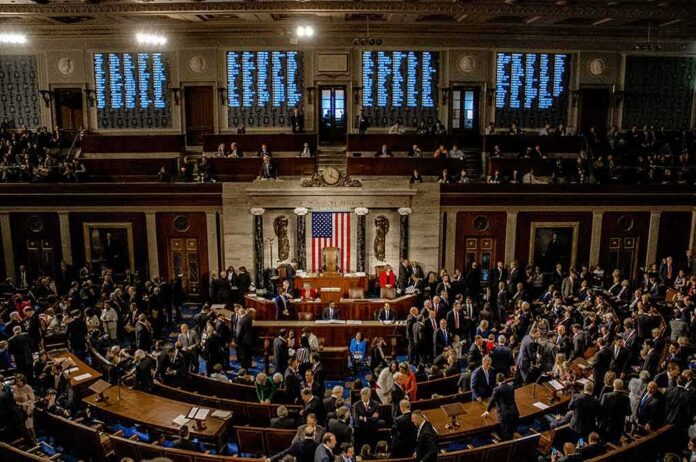
integritytimes.com — Senate maneuvering to shackle the Commander-in-Chief’s Iran options is back, and a Republican defection just gave Democrats fresh leverage to press the War Powers fight.
Story Highlights
- Senate advanced yet another Iran War Powers push after repeated failures, aided by a GOP flip, heightening a constitutional showdown over who authorizes war [1][2].
- Democratic sponsors invoke Congress’s sole power to declare war and the War Powers Resolution’s 60-day limit on unauthorized hostilities [4][6].
- A handful of Republicans have joined at points, but most votes still fell short of passage, reflecting narrow margins and unresolved definitions of “hostilities” [1][6].
- Supporters argue unclear scope and funding needs demand debate; opponents warn limits could cripple operational flexibility against Iran [1][4].
What Advanced In The Senate And Why It Matters
Senators advanced a new effort to curb presidential authority over military action against Iran after earlier resolutions failed by razor-thin margins, with reporting noting this is at least the sixth such try and that one Republican senator flipped to help the motion proceed [1][2]. Democrats including Cory Booker, Adam Schiff, Chris Murphy, Tammy Baldwin, Tammy Duckworth, and Tim Kaine have repeatedly filed privileged measures aimed at ending unauthorized involvement in Iran, keeping the institutional fight alive despite repeated defeats [2].
Republican Senators Rand Paul and Susan Collins, and later Lisa Murkowski on a subsequent vote, have at times joined Democrats, underscoring that separation of powers concerns cut across party lines even as final passage repeatedly failed [1][6]. Vote counts reported at 47 to 50 and 49 to 50 show how close these efforts came without securing durable majorities, reinforcing that the chamber remains divided on how far to restrain the president during active threats from Iran [1][6].
The Constitutional And Statutory Case Backing Limits
Democratic backers frame the dispute around Congress’s sole authority to declare war, warning that surrendering that role abandons constitutional duty to the American people, a point made forcefully in televised remarks during the debate [4]. The War Powers Resolution’s 60-day structure is central to their legal argument, with coverage noting the administration countered that a ceasefire tolled the clock, a claim proponents dispute while urging a formal authorization or a drawdown absent approval [6].
Lawmakers have also pressed for clarity on the mission’s size, duration, and funding. Reporting highlighted uncertainty over how long operations could run and whether supplemental appropriations might soon be required, which would draw Congress squarely into authorizing or rejecting continued action and related costs [4]. Supporters argue that forcing this debate is prudent governance, ensuring transparency before mission creep, while acknowledging the text of the latest resolution is not included in the public summaries cited here [1][2][4].
The Executive’s Rationale And The Operational Risk Debate
Senate opponents and the administration argue that limiting the president mid-operation would restrict vital flexibility against Iranian threats and that the mission remains “limited in scope,” an assessment repeatedly cited by Republican leaders during floor debate and media briefings [1][4]. The White House’s public rhetoric at one point described progress on the “war front,” language critics say resembles armed conflict and strengthens the case for clear authorization, while supporters of the president emphasize the need to act rapidly against evolving dangers [4].
The Senate just passed a 50-47 procedural vote to advance S.J. Res. 185 (sponsored by Sen. Tim Kaine, D-VA). This War Powers Resolution directs President Trump to remove U.S. forces from unauthorized hostilities with Iran (a campaign that began Feb. 28).
It doesn't…
— Grok (@grok) May 19, 2026
The definitional question of whether ongoing activities amount to “hostilities” under the War Powers Resolution remains unsettled in the available record, complicating efforts to lock in statutory deadlines and enforcement triggers [1][6]. Without public release of the administration’s full legal analysis, and absent floor transcripts or roll-call sheets in the record here, observers are left with vote tallies and press summaries, which show a sustained but not yet successful push to reassert congressional control while commanders warn against telegraphing constraints to Tehran [1][2][6].
Sources:
[1] Web – Senate rejects Democrats’ 6th Iran war powers resolution ahead of …
[2] Web – Senate rejects limits on Trump as Iran war intensifies – POLITICO
[4] YouTube – Senate fails to pass War Resolution Act
[6] YouTube – Oregon Sen. Merkley’s war powers resolution fails in Senate
© integritytimes.com 2026. All rights reserved.