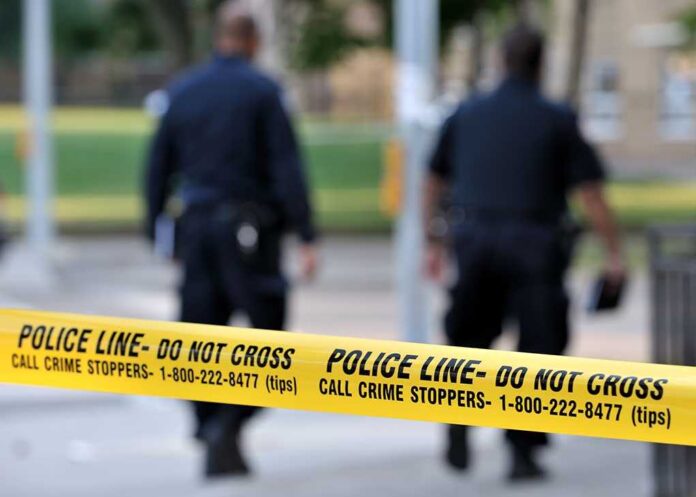
One man in a van with a replica rifle turned a Boyle Heights street into the front line of America’s growing war over police power, fake guns, and what “reasonable fear” really looks like when bullets start flying.
Story Snapshot
- Police answered a 911 call about a man with a “possible assault rifle” sitting in a van in Boyle Heights.
- Officers say Jeremy Flores raised a realistic MP5-style BB airsoft rifle and triggered their decision to shoot.
- His family insists the gun stayed on his lap, he was seat‑belted, gravely wounded, and physically unable to obey post‑shooting commands.
- Video released by the Los Angeles Police Department (LAPD) is edited, missing key angles, and now sits at the center of a bitter fight over trust.
A tense 911 call and a van that looked like a gun nest
Officers did not roll into Boyle Heights on a hunch. Dispatch sent them to Spence and 8th Street after a verified 911 caller reported a man in a van holding a “possible assault rifle.” The caller’s words matter. When someone says “assault rifle” in a city already on edge about gun crime, officers arrive primed for a worst‑case scenario, not a casual chat. From the start, this was treated like a lethal threat, not a welfare check. That frame shaped every move that followed.
Body‑worn camera video and LAPD’s own briefing show officers taking up positions around Flores’s van, weapons drawn, voices sharp. They order him, again and again, to get out, drop the gun, and show his hands. One officer warns, “You will get shot, dude,” making clear that continued defiance could turn deadly. From a conservative law‑and‑order view, these commands check the basic boxes: clear, repeated, and tied to a direct warning about the consequences of noncompliance.
The fake MP5 that did not look fake at all
Later, LAPD confirmed the gun in the van was not a real assault rifle but an MP5‑style BB airsoft rifle. It was battery powered and capable of firing metallic projectiles, designed to mimic a compact automatic weapon. From a few yards away, in poor lighting, no reasonable person expects officers to guess “toy.” A statewide study of force in California found that about six percent of deadly encounters involve firearm replicas, underlining that fakes are a real part of the problem, not a rare footnote. Realistic toy guns now live in the same mental category as the real thing during tense calls.
LAPD identified three Hollenbeck Division officers as the shooters: Livier Jimenez, Fernando Godinez, and Michael Ruiz. Naming officers matters for public accountability, but it also reminds us that human beings stood outside that van making split‑second decisions. These were not faceless uniforms. They were individuals whose careers, freedom, and families now hang on whether investigators agree that their fear of that replica rifle met the legal standard for justified lethal force.
The missing moment and the fight over what really happened
Here is where the story blows open. LAPD’s official narrative says Flores refused to obey commands, raised the rifle, and pointed it in the officers’ direction, prompting the shooting. But the department has also admitted that the body‑worn cameras “did not provide a clear picture of the suspect’s actions at the time of the shooting.” In plain English, the cameras do not clearly show the exact move that supposedly forced their hand. That evidentiary hole fuels every doubt that followed.
Flores’s family and activists argue that the released video is “highly edited” and leaves out a crucial head‑on view of officers firing. They say the weapon was on his lap, not raised, and that “there is no evidence whatsoever that he pointed it at anyone.” His girlfriend says he was wearing a seatbelt and gravely injured from the first volley, making claims that he “refused to exit” after the shooting sound more like spin than fact. From a common‑sense conservative perspective, that criticism is fair: if the key angle exists, the full, raw footage should be out by now.
Replica guns, rising shootings, and why cops are pulling triggers faster
Flores’s death is not an isolated oddity. Los Angeles has seen a sharp rise in officer‑involved shootings, including incidents with replica firearms. LAPD’s own public briefings acknowledge more encounters with guns, more knives, and more imitation weapons, and they say officers have “few options once they’ve been attacked with a lethal weapon.” Across California, data show that in about eighty percent of fatal encounters, officers both perceived and confirmed the presence of a dangerous weapon, including firearm replicas. When everything looks like a gun, more situations end like this one.
Nationwide research backs up this structural pressure. States with higher household gun ownership see much higher rates of fatal police shootings, largely driven by more civilians being armed with firearms. That risk bleeds into how officers read every movement. When a suspect in a van appears to lift what looks like a compact rifle, officers see not a curious object but a direct threat to their lives. From a conservative angle that values officer safety, it is obvious why policy and training lean toward “shoot when in doubt” once a weapon is raised.
A community that does not trust the edit button
Boyle Heights residents are not simply upset; they are organized. Rallies and vigils have pushed for the release of full, unedited body‑cam and tactical drone footage, especially the missing head‑on angle. Activists call the LAPD video “doctored,” and that word lands hard in a city with a long memory of police scandals. California laws like AB 748 and SB 1421 force agencies to release footage within set deadlines, but critics say departments comply in letter, not spirit, by trimming the most damaging moments. That pattern erodes faith even when a shooting might meet the legal standard.
The California Department of Justice now investigates fatal shootings of unarmed persons, and broader state rules require outside review of deadly force cases. The Flores case remains under active investigation, so there is no final official ruling yet. While facts are sorted, the political battle is already decided for many locals: they see a man in distress, a fake gun, edited footage, and a familiar story of power protecting itself. For conservatives who care both about law and order and honest government, the path forward is obvious—demand full footage, clear timelines, and hard data, not just carefully cut narratives, so citizens can judge whether “reasonable fear” really applied inside that van.
Sources:
nypost.com, thelalocal.org, latimes.com, abc7.com, fightbacknews.org, youtube.com, facebook.com, lapdonline.org, reddit.com
© integritytimes.com 2026. All rights reserved.