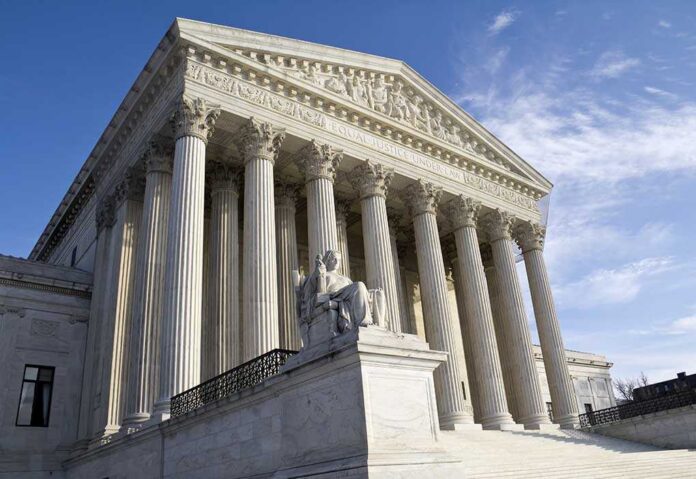
integritytimes.com — Gunfire outside a Supreme Court justice’s home turned out to be something far less cinematic than an assassination attempt and far more revealing about how quickly America now jumps to the worst possible story.
Story Snapshot
- Police say the shooting outside Justice Sonia Sotomayor’s residence stemmed from an attempted carjacking of her U.S. Marshal security detail, not a targeted attack.
- Officials report the suspect was charged with armed carjacking and related firearm offenses after allegedly tapping a gun on the Marshal’s window.[1][2]
- The justice’s home quickly became a political symbol before basic facts were nailed down, echoing a broader pattern in high-profile violence coverage.
- Meanwhile, the Supreme Court is reshaping when police may enter homes in emergencies, raising hard questions about both safety and liberty.[1][5]
What Actually Happened Outside the Justice’s Home
Washington, D.C. police say that around 1:15 a.m., two deputy United States Marshals sat in separate sport utility vehicles outside the residence of Supreme Court Justice Sonia Sotomayor when an armed eighteen-year-old approached one vehicle and tapped a handgun on the window.[1][2] The Marshals, assigned to protect Supreme Court justices’ homes, opened fire, striking the suspect and causing non‑life‑threatening injuries before police arrested him.[1][2] Officers later charged him with armed carjacking and multiple firearm offenses.[1][2]
Law enforcement sources describe the episode as an apparent carjacking attempt rather than an ideologically driven attack on the justice.[1][2] Metropolitan Police and federal officials have publicly stated there is no indication the suspect knew whose home he was near or that he targeted the justice herself.[2] The suspect allegedly arrived in a minivan, approached what he likely saw as a desirable Dodge Durango, and picked, as one reporter put it, “the wrong car to try to carjack.”[2] That is a far cry from a planned assassination.
How Early Narratives Outran the Sparse Facts
Media and online commentary moved faster than the evidence. The phrase “shooting outside a Supreme Court justice’s home” practically writes its own thriller script, and some commentators leaned into that, treating proximity as proof of motive. But the available record contains no contemporaneous police report, no charging language, and no investigative statement tying the gunfire to an effort to kill or intimidate the justice. The identified charges fit carjacking, not terrorism or attempted murder of a federal official.[1][2]
The search record around this incident is telling for what it lacks. There is no public ballistics reconstruction, no mention of bullets striking the residence, no suspect manifesto, and no digital trail referencing the justice or her address. Claims that this was a targeted attack rest largely on inference and fear, not documented proof. That vacuum is fertile ground for political storytelling on both sides, which is exactly why a sober, evidence‑first approach aligns with conservative instincts about personal responsibility and truth‑in‑reporting.
When Real Targeted Threats Look Very Different
Genuinely targeted judicial attacks leave a very different paper trail. In the 2022 plot against Justice Brett Kavanaugh, the would‑be attacker traveled across the country with a suitcase of weapons, arrived at Kavanaugh’s home, and then called 911 on himself, admitting he had come to kill a specific Supreme Court justice.[3][4] Federal charging documents cited his own statements about abortion, gun rulings, and online chats boasting he would “remove some people from the Supreme Court.”[4]
Investigators in that case recovered a Glock pistol, zip ties, a tactical knife, pepper spray, and burglary tools, and a federal grand jury indicted the defendant for attempted murder of a Supreme Court justice.[4] Those are the kinds of facts that justify using words like “assassination plot.” By contrast, the Sotomayor‑detail shooting currently looks like a young criminal chasing a popular vehicle model who happened to run into armed federal officers.[1][2] Confusing these categories cheapens the word “assassination” and warps public debate about real threats to institutions.
The Supreme Court’s Parallel Fight Over Police and Home Entry
While pundits argued over the meaning of gunfire outside a justice’s home, the Court itself wrestled with a different kind of front‑door crisis: when police may enter a home without a warrant in response to possible danger. In Case v. Montana, officers forced entry after a report that a man might have shot himself; once inside, they shot the occupant, triggering a constitutional fight over the “emergency aid” exception to the Fourth Amendment.[1][5]
The Court’s recent decisions stress that officers may enter only when they have an objectively reasonable basis to believe someone inside faces serious injury or imminent threat, not simply because a situation feels tense.[1][5] That insistence on evidence before intrusion mirrors what citizens should demand in public narratives: probable cause, not panic, before declaring any gunshot near a famous figure a political hit. The same Constitution that protects justices’ safety also guards the sanctity of the home and the presumption of innocence.
Why Clear Facts Matter More Than Viral Fear
Episodes like this expose a deeper tension in American life. Violence is real; carjackings, mass shootings, and actual plots against officials all exist. But a culture that treats every dramatic headline as proof of its worst suspicions loses the ability to distinguish between stray crime and organized terror. That confusion encourages overreach from government on one side and fatalism from citizens on the other, eroding trust in both police and courts.
A conservative, common‑sense posture starts with humility about what we do not yet know. When police and prosecutors eventually release full reports—911 calls, trajectory diagrams, surveillance footage—those documents should drive the story, not the other way around. If the evidence remains exactly what it looks like today, this was a serious crime against property and officers, not an attack on the Republic. Protect the justices, prosecute the carjackers, and keep the word “assassination” reserved for the evil that truly fits it.
Sources:
[1] Web – Report: Police Rush to Supreme Court Justice’s Home After Gunfire …
[2] Web – CASE v. MONTANA | Supreme Court – Law.Cornell.Edu
[3] Web – Shooting prompts Supreme Court to tighten emergency warrantless …
[4] Web – Shooting prompts Supreme Court to tighten emergency warrantless …
[5] Web – Justices Reject “Moment of Threat” Rule in Police Shooting Case
© integritytimes.com 2026. All rights reserved.