
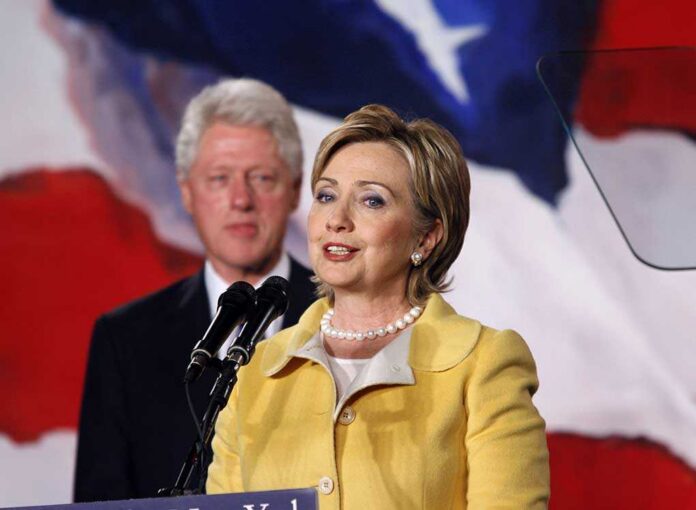
A former First Lady and presidential candidate spent six hours dodging questions about a deceased pedophile before emerging to declare victory over her Republican inquisitors.
Story Snapshot
- Hillary Clinton testified for six hours on February 26, 2026, denying any connection to Jeffrey Epstein while accusing GOP committee members of political theater
- The closed-door deposition halted briefly when Rep. Lauren Boebert allegedly violated protocol by sharing a photo from inside the room
- Clinton claimed questions veered into conspiracy territory including UFOs and Pizzagate, though she praised Chairman Comer’s final substantive inquiries
- This marks the first time a former presidential couple faced congressional subpoenas in decades, with Bill Clinton scheduled to testify the following day
- Republicans expressed frustration with Clinton’s responses while Democrats framed the probe as deflection from Trump’s own Epstein connections
When Congressional Oversight Becomes Political Theater
The House Oversight Committee’s February 26 session at the Clintons’ Chappaqua residence exposed the raw friction between constitutional oversight and partisan warfare. Hillary Clinton arrived at 11 a.m. to face questions about Jeffrey Epstein’s network, emerging six hours later with a prepared counterattack against what she characterized as a Republican witch hunt. Chairman James Comer called the deposition productive. Rep. William Timmons called Clinton obstinate, noting she had an excuse for everything. The divide reveals Congress struggling to balance legitimate investigation with credibility-destroying spectacle.
The Road to Subpoenas and Contempt Threats
The current drama traces back to August 2025 when the committee issued subpoenas following President Trump’s directive for DOJ to investigate Epstein’s connections to high-profile figures. Bill Clinton’s name appeared prominently in Epstein documents detailing multiple flights on the financier’s plane during 2002-2003. When the Clintons skipped their January 2026 appearances, the committee voted bipartisan contempt charges carrying potential one-year jail terms and 100,000-dollar fines. The couple relented just before a full House vote, agreeing to closed-door depositions that Democrats argue should apply equally to Trump.
What Clinton Said and What She Avoided
Clinton’s core testimony centered on categorical denials. She stated she never met Epstein and barely knew Ghislaine Maxwell, explaining Maxwell attended Chelsea Clinton’s wedding as someone’s plus-one. Republicans found this unsatisfying given Maxwell’s documented presence at Clinton family events. Post-deposition, Clinton accused GOP members of wasting time on debunked conspiracies while praising Comer’s closing questions as substantive. She advocated for public hearings rather than closed sessions, arguing transparency serves truth better than secrecy. Rep. Suhas Subramanyam countered that Clinton ran circles around Republicans while providing zero new information.
The Protocol Breach That Paused Everything
The deposition ground to a halt when Rep. Lauren Boebert allegedly shared a photo from inside the closed-door session, violating committee rules designed to protect witness privacy and investigative integrity. The incident underscored tensions already boiling over, with both parties accusing each other of leaks. Democrats pointed to the Boebert breach. Republicans noted Democrats leaked session details to media. The mutual rule-breaking transformed what should be solemn constitutional duty into a proxy battle for political advantage, eroding public confidence in Congress’s ability to conduct serious oversight.
The Partisan Divide Over Epstein Accountability
Republicans frame their investigation as pursuing legitimate questions about foreign influence, Clinton Foundation funding, and associations with a convicted sex offender whose crimes harmed numerous victims. Democrats counter that Trump maintained his own Epstein relationship including documented events at Mar-a-Lago, yet the DOJ withholds files on alleged abuse claims. Ranking Member Robert Garcia called the Clinton depositions a long-running Republican dream to stir controversy. The fundamental question remains whether Congress seeks truth or political ammunition, and whether Americans can distinguish between the two anymore.
Hillary Clinton comes out swinging after GOP grilled her during marathon Epstein deposition. By Elizabeth Elkind, Fox News Published February 26, 2026, 7:01 pm EST "So, I appreciated that. I want to see the truth come out. So, that was a reassuring way to end a very long,…
— OrygunGuy2001 (@OrygunGuy2001) February 27, 2026
Bill Clinton faced his own deposition on February 27 at the same Chappaqua location. His testimony carries different weight given his documented presence on Epstein’s plane and in photographs with the financier. Republicans anticipated tougher questioning for the former president. The broader investigation continues with potential public hearings ahead, though the partisan rancor suggests any findings will be filtered through competing political narratives rather than accepted as objective fact. The Clintons’ legal strategy of compliance under contempt threat rather than cooperation may set precedent for future congressional investigations, particularly if Democrats pursue Trump subpoenas using the same playbook.
Sources:
Axios – Hillary Clinton deposition Epstein investigation House Oversight
Politico – House Republicans say Hillary Clinton punted questions on Epstein
CPR – Lauren Boebert photo pausing Hillary Clinton Epstein deposition